Discover why hiring LATAM developers ensures faster remote team integration for US firms. Scale your squad with Latin American software engineers at Blue Coding.


.svg)
.svg)
The shift toward hiring in Latin America has become a strategic necessity for US companies that need to scale without the friction of traditional offshoring. If you have ever managed a team across a 12-hour time difference, you know the pain of the lag. You send a message at the end of your day, wait an entire night for a response, and lose a full week of progress to a single misunderstanding. This is why hiring developers in LATAM has become the gold standard for high-growth teams. When you focus on hiring LATAM talent, the friction that usually breaks remote teams disappears. It is not just about physical proximity. It is about a shared rhythm of work that makes remote team integration feel natural rather than forced. In this guide, we will break down exactly why Latin American software engineers are outperforming other regions when it comes to speed of integration and long term impact.
The most immediate benefit of hiring LATAM talent is the timezone alignment. Most major tech hubs in South and Central America operate within the same window as New York, Chicago, or San Francisco. In a modern agile environment, communication needs to be instant. If a bug is found during a deployment at 10:00 AM EST, you need your lead engineer on the line immediately. Latin American software engineers are at their desks when you are. This allows for true pair programming. You no longer have to record videos of your screen and hope the other person understands them. You can hop on a call and solve problems live. It also creates instant feedback loops. Pull request reviews that used to take 24 hours now take 20 minutes. Most importantly, it builds cultural presence. Being in the same timezone allows remote workers to participate in the casual moments on Slack or Zoom that build genuine team chemistry.
Integration is not just about writing code. It is about understanding the mission. Many offshore models fail because the developers act like order takers. They wait for a ticket, finish the task, and clock out. By contrast, the tech culture in Latin America is heavily influenced by the US startup ecosystem. Many senior developers in the region have spent their careers working for US-based firms. This means they already speak the language of product led growth. They understand terms like MVP, churn, and user journey without needing a primer.
When you prioritize hiring developers in LATAM, you are bringing in people who challenge the status quo. They will not just build a broken feature because it was in the requirements. Instead, they will flag it and suggest a better way. They also prioritize communication. High English proficiency combined with a direct, Western-style communication approach means fewer lost-in-translation moments. These engineers are used to pivoting based on market needs, making them incredibly resilient and fast-moving.
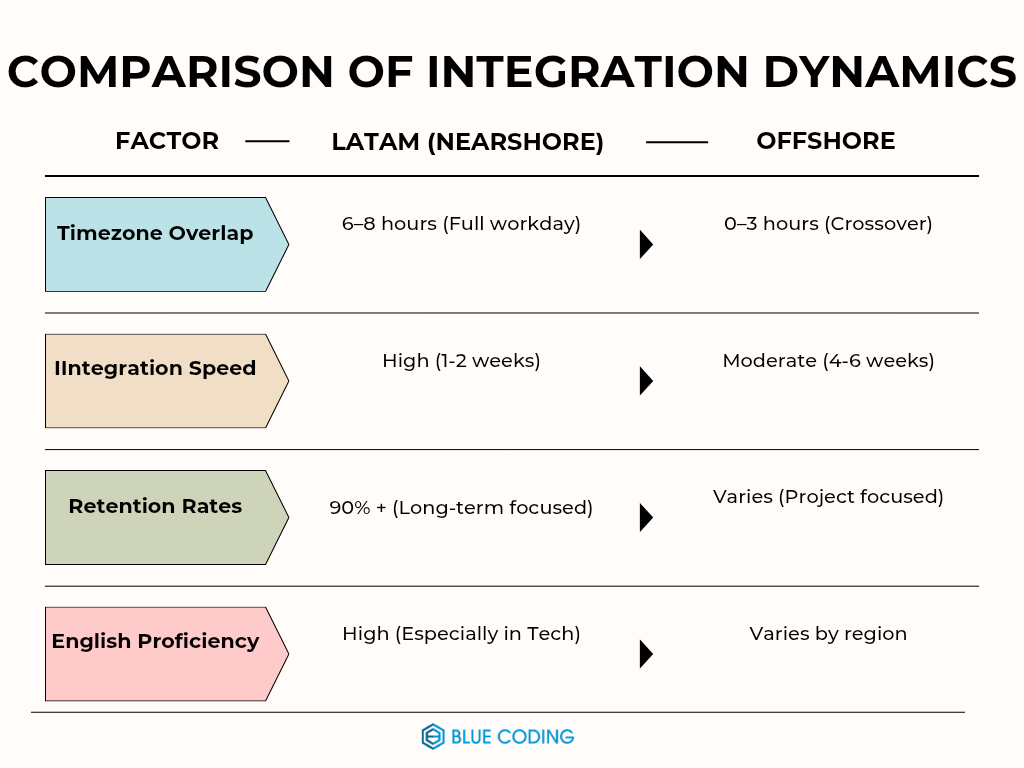
The talent pool in Latin America has matured significantly over the last few years. We are seeing a massive influx of specialized expertise that matches any hub in the world. Latin American software engineers are leading the way in several key sectors. Brazil and Mexico have some of the most advanced digital banking systems globally. This has created a generation of developers who are experts in security and high-volume transactions. With the explosion of AI tools, LATAM hubs have pivoted faster than many traditional markets. They are already integrating machine learning into standard dev workflows. There is also a strong DevOps maturity. The focus has shifted from just writing code to owning the entire pipeline. This ensures that integration is not just a management term, but a technical reality.
One of the hidden killers of remote team integration is high turnover. If a developer leaves after six months, you lose all the time you spent onboarding them. Because of the prestige and competitive pay offered by US companies compared to local markets, developers in LATAM show significantly higher loyalty. They are not looking for the next exit. They are looking to grow within your company. This stability allows your internal knowledge base to grow stronger every year rather than starting from zero every time a seat changes.
Successful remote team integration depends on technical skills and on shared values. Latin American culture places a high value on social connection and collaboration. This translates into the workplace as a high degree of empathy and team spirit. When you are hiring LATAM professionals, you are hiring people who want to be part of a team, not just a line item on a spreadsheet.
This cultural alignment extends to business practices. The way meetings are run, the way feedback is given, and the way deadlines are managed in LATAM are very similar to North American standards. This reduces the cognitive load on your managers. They do not have to learn a completely new set of cultural protocols to get the best out of their engineers.
While the primary reason for hiring developers in LATAM should be quality and integration speed, the economic benefits are undeniable. You can often hire senior-level talent for the same cost as a mid-level developer in the US. This allows you to scale your team faster and tackle more complex projects without blowing your budget.
However, the real value is in the return on investment. A developer who integrates in two weeks and stays for three years is infinitely more valuable than a slightly cheaper developer who takes three months to learn your systems and leaves after a year. This is the competitive edge that LATAM offers.
Some leaders still worry about the quality of remote education or the reliability of infrastructure. In 2026, these concerns are largely outdated. Countries like Colombia, Argentina, and Uruguay have invested heavily in high-speed internet and technical universities. The engineers coming out of these regions are often more technically rigorous than their counterparts in the US because they have had to compete on a global stage from day one.
Another myth is that English levels are a barrier. In reality, the tech community in LATAM is overwhelmingly English first. Most documentation, coding languages, and global forums are in English, and the engineers you will find through hiring LATAM programs are typically fluent.
If you want to excel at remote team integration, you must treat your LATAM hires as core team members. This means including them in all hands meetings, giving them access to the same tools, and offering them the same growth opportunities as your local staff. When you bridge the gap between nearshore and onshore, you create a unified force that can outpace any competitor.
Building a high-performing digital team should never feel like you are managing an isolated department. Blue Coding believes that your engineers should function as a natural extension of your home office. By focusing your talent search on the same hemisphere, you effectively remove the most common obstacles to success, such as time zone gaps, geographical distance, and cultural misalignment. The faster your team can integrate, the faster your company can ship products, and in the competitive landscape of 2026, delivery speed is the metric that defines market leaders. Latin America is no longer just a future possibility for the tech industry; it is the current standard for excellence. Companies that embrace this shift now gain a significant advantage in the global race for top-tier talent. Whether you are leading a high-growth startup or a large-scale enterprise, the most efficient path to a cohesive remote team leads directly to LATAM. To help you navigate this transition, Blue Coding also offers an initial complimentary strategy call to discuss your specific goals and how we can streamline your hiring process.


Subscribe to our blog and get the latest articles, insights, and industry updates delivered straight to your inbox