Human vs AI coding isn’t the real debate. This deep and detailed analysis explains how smart teams use AI without sacrificing engineering quality.

.svg)
.svg)
AI-assisted development has quietly moved from an efficiency upgrade to a defining force in modern software engineering. In 2026, automation is helping developers write code faster, and it is influencing how systems are designed, how decisions are made, and how products evolve over time. As AI becomes more embedded in development workflows, a new line is emerging between what machines can automate and what only human engineers can own. Understanding that boundary is no longer optional. It is essential for teams that want to scale responsibly, protect quality, and build software that actually serves business intent.
If 2025 was the year developers hesitated at the edge of AI-assisted development, 2026 is shaping up to be the year we leap, not blindly into full automation, but deliberately into intelligent collaboration where tools do the heavy lifting and humans shape the meaning. Across the industry, AI coding assistants are evolving from autocomplete helpers into context-aware copilots that can optimize architectures, suggest refactors, and generate test suites. This shift is pushing automation beyond repetitive tasks and into semi-autonomous software creation workflows that fundamentally change how teams build products. At the same time, natural-language programming and autonomous DevOps pipelines are blurring the line between human intent and machine execution. Developers are no longer just writing code faster. They are describing what they want to build, while AI determines how to construct it. Tools that once lived at the edges of development are now deeply embedded into CI/CD pipelines, security validation, and infrastructure automation. As a result, the developer experience is moving away from syntax and toward design, decision-making, and accountability.
What makes 2026 truly surprising, however, is the tension this progress creates. Adoption is accelerating rapidly, yet trust is still catching up. Teams are being forced to rethink governance, validation, and ownership of AI-generated outputs. Automation is not replacing engineers. It is raising the bar, demanding sharper judgment, stronger system thinking, and a clear understanding of where human engineering must remain firmly in control.
For businesses already investing in nearshore software development, AI-assisted software development represents the next logical evolution of that model. Nearshoring has long been valued for cost efficiency, time-zone alignment, and access to strong engineering talent. What AI adds in 2026 is leverage. It allows the same teams to deliver more value without linear increases in headcount or timelines. As the concept of AI in software engineering and its tools mature, businesses are realizing that the combination of nearshore talent and intelligent automation creates a delivery engine that is faster, more adaptive, and better aligned with business priorities. This is no longer about experimenting with tools. It is about building operational advantage into how software is produced.
One of the strongest reasons businesses should encourage AI-assisted software development is its direct impact on delivery speed. AI tools now handle large portions of boilerplate code generation, refactoring suggestions, test creation, and documentation updates. In nearshore environments, this shortens sprint cycles and reduces dependency on long handoffs. More importantly, speed does not come at the cost of quality. Automated testing, code analysis, and real-time feedback help catch issues earlier, reducing technical debt before it compounds. For business leaders, this translates into faster releases, fewer delays, and more predictable roadmaps without pushing teams into burnout.
Nearshore development already offers financial advantages, but AI amplifies them. When repetitive tasks are automated, businesses pay less for low-value manual effort and more for strategic thinking and problem-solving. This improves cost efficiency across the full software lifecycle, not just during development. Fewer defects mean lower maintenance costs. Better code quality means less rework. Faster onboarding through AI-supported documentation and code understanding reduces ramp-up time for new developers. Over time, these gains compound. For companies managing multiple products or scaling quickly, AI-assisted nearshore teams deliver measurable ROI rather than just lower hourly rates.
AI-assisted development is quietly changing how technical and non-technical stakeholders collaborate. Natural-language tools allow product managers, architects, and business leaders to communicate intent more clearly, which AI can then translate into technical execution paths. In nearshore setups, where clarity is critical, this reduces misunderstandings and accelerates decision-making. Instead of long clarification cycles, teams align faster around requirements, priorities, and trade-offs. Businesses benefit because strategy flows more directly into execution, and nearshore teams operate less like external vendors and more like true product partners.
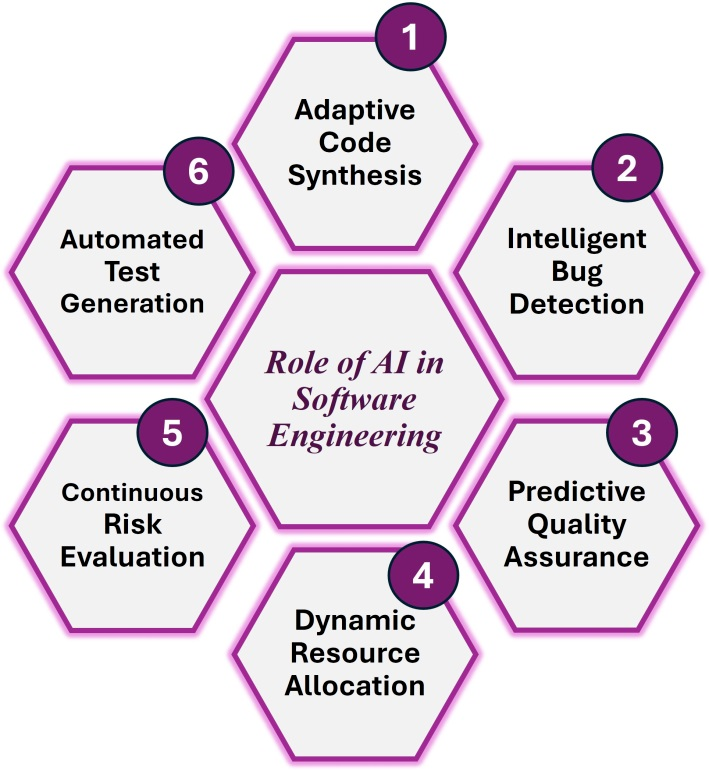
From a business perspective, risk management is just as important as speed and cost. AI-assisted development strengthens this area significantly. Automated security scanning, vulnerability detection, and regression testing reduce the likelihood of critical issues reaching production. For nearshore teams managing complex systems, this creates a safety net that supports consistent quality even as velocity increases. Businesses experience fewer emergency fixes, fewer reputational risks, and greater confidence in release cycles. In regulated or high-availability industries, this reliability becomes a decisive factor in choosing how and where development happens.
A common misconception is that AI in software engineering diminishes the value of human engineers. In reality, the opposite is happening. AI removes the most repetitive, draining parts of development and elevates the role of engineers toward architecture, system design, and problem-solving. For nearshore teams, this is especially powerful. Skilled developers become more engaged, retention improves, and teams produce higher-quality work. Businesses benefit from stronger continuity, deeper domain knowledge, and teams that grow alongside the product instead of simply executing tickets. Encouraging AI use is not about replacing talent. It is about unlocking its full potential.
Growth often introduces complexity, especially when teams expand across regions. AI-assisted development helps businesses scale nearshore operations without losing control. Standardized coding practices, AI-supported reviews, and automated quality checks create consistency across distributed teams. This makes it easier to add new developers, onboard new products, or expand into new markets without rebuilding processes from scratch. For business leaders, this means growth feels intentional rather than reactive. Systems scale, teams scale, and governance scales with them.
By the end of this year, AI-assisted development is no longer a differentiator on its own. What differentiates businesses is how intentionally they adopt it. Companies that encourage AI within nearshore teams move faster, adapt quicker, and respond better to market shifts. Those who hesitate risk being outpaced by competitors delivering features faster and at lower cost. Encouraging AI-assisted development signals to clients, investors, and talent that the business is future-ready and serious about innovation. In an environment where software defines competitive positioning, that signal matters.
Ultimately, encouraging automation in development in nearshore teams is not a short-term optimization. It is a long-term investment in how a business builds, evolves, and sustains its digital products. It creates a development culture that values efficiency, quality, learning, and strategic thinking. Nearshore teams become more than delivery units. They become innovation partners supported by intelligent systems. For businesses looking beyond the next release and toward sustained growth, this combination is difficult to ignore and even harder to replicate once competitors move ahead.
The idea that AI will replace software developers continues to circulate, but in practice, it misunderstands what development actually is. Writing code is only a visible fraction of the job. The real value of human developers lies in judgment, context, accountability, and the ability to make trade-offs when requirements conflict or reality shifts. AI can generate solutions based on patterns, but it cannot understand business intent, user emotion, ethical implications, or long-term product vision in the way humans do. Software is not built in a vacuum. It evolves through ambiguity, constraints, and constant change, all of which require human reasoning and ownership.
At the same time, dismissing AI as a threat misses the opportunity it presents. AI assistance removes friction from development by handling repetitive tasks, surfacing suggestions, and accelerating experimentation. This allows developers to spend more time designing systems, questioning assumptions, and improving outcomes. Rather than replacing engineers, AI raises the bar for what good engineering looks like. The future of software development is not human versus machine. It is human judgment amplified by intelligent tools, where developers remain the decision-makers, and AI becomes a force multiplier that makes their work more impactful, not obsolete.
Blue Coding views AI-assisted development as a way to amplify strong engineering teams, not replace them. When combined with experienced nearshore talent, AI helps reduce friction, improve quality, and accelerate delivery while keeping human judgment and accountability at the center. We focus on applying automation where it adds real value and preserving human leadership where strategy, context, and decision-making matter most. If you are exploring how to use AI responsibly in your software initiatives, we offer a free initial strategy call to discuss your queries! Contact us now to get started!


Subscribe to our blog and get the latest articles, insights, and industry updates delivered straight to your inbox