Ready to scale your team? Explore the latest Latin America outsourcing data to see how top firms save up to 60 percent on senior talent while maintaining high quality and total agility.


.svg)
.svg)
The search for high-quality software developers often feels like an endless cycle of high salaries and even higher turnover. For a long time, the only alternative was to look halfway across the world to traditional offshore hubs. While the low hourly rates were tempting, many leaders found that the hidden costs of massive time zone gaps and cultural friction often outweighed the initial savings. The landscape has changed. Tech leaders are now prioritizing proximity and alignment over the absolute lowest price point. This shift has turned nearshoring from a niche experiment into a primary business strategy for the most successful companies in North America. To understand why this is happening, we have to look at the hard numbers. The following data points explain why the software development world is moving toward a nearshore model.
The most logical place to start is with the sheer scale of the industry. The IT outsourcing market size is currently valued at hundreds of billions of dollars and shows no signs of slowing down. Analysts suggest that the global market for outsourced services will grow at a compound annual rate of nearly 8 percent over the next several years.
This growth is being fueled by a desperate need for digital transformation. Companies are no longer just building websites. They are building complex AI models, migrating massive data sets to the cloud, and creating intricate mobile ecosystems. Because the local talent pool in the United States cannot keep up with this demand, the IT outsourcing market size continues to expand as businesses look for sustainable ways to scale their engineering teams.
When we look at nearshore outsourcing statistics, we see a clear trend toward regionalization. More than 45 percent of companies that previously used offshore providers in Asia or Eastern Europe are now shifting at least a portion of their work to nearshore partners.
The reasons for this shift are grounded in operational efficiency.
According to recent nearshore outsourcing statistics, companies that utilize nearshore teams report a 30 percent increase in project delivery speed compared to those using offshore models with significant time gaps. This is because decisions can be made in real time during the standard workday.
Latin America has become the premier destination for nearshoring for several key reasons. When you examine the Latin America outsourcing data, you see a region that has spent the last two decades preparing for this moment.
There are now over 2 million professional developers across Latin America. Countries like Mexico, Brazil, and Colombia lead the way in terms of sheer numbers, but smaller hubs like Uruguay and Costa Rica are producing some of the highest quality specialized talent in the world.
One of the most critical data points in Latin America outsourcing data is the rise of English proficiency. In many major tech hubs like Buenos Aires and Mexico City, English is the standard language for technical documentation and meetings. This reduces the risk of requirements being lost in translation, which is a common failure point in global outsourcing.
The IT services sector in Latin America is growing at a rate of about 5 to 7 percent annually. This is supported by government initiatives that provide tax incentives for tech companies and funding for STEM education. This creates a stable environment where companies can build long-term teams rather than just hiring temporary contractors.
Let’s talk about the financial side of the equation. While nearshoring is not always as cheap as the lowest offshore options, it provides a much higher level of value per dollar spent.
Recent financial surveys show that the average cost savings when moving from a US-based team to a Latin American nearshore team range from 40 to 60 percent.
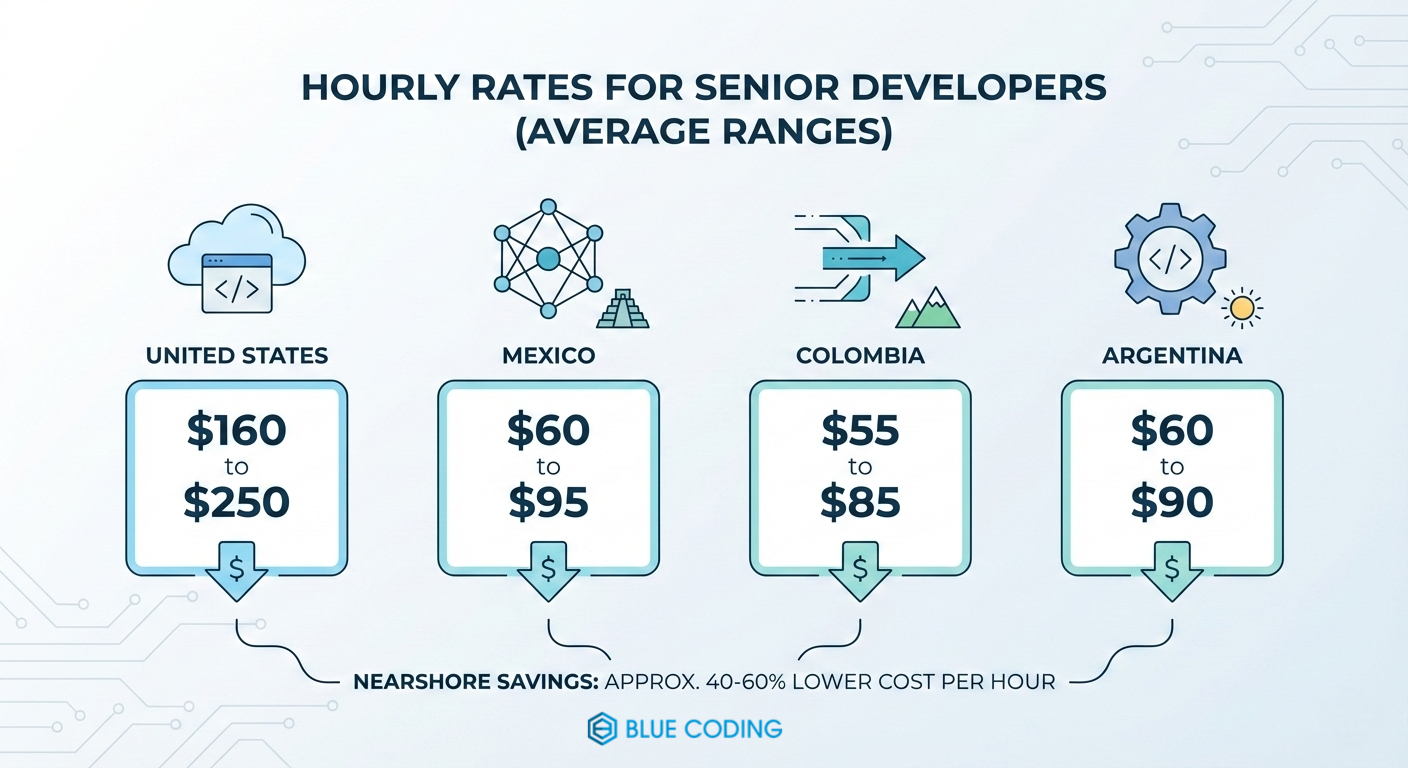
These numbers show that a company can essentially double its engineering capacity for the same budget while maintaining a high level of quality. Because these developers are in similar time zones, you do not need to hire extra project managers just to handle the communication hand-offs.
As we look at the immediate future, several nearshoring trends 2026 are becoming apparent. The most significant trend is the rise of the AI-integrated developer. Nearshore firms are not just providing bodies to write code. They are providing engineers who are experts in using AI tools to accelerate the development lifecycle. This means that a nearshore developer in 2026 can often produce the same output as two developers from five years ago.
Another of the key nearshoring trends 2026 is the move toward long-term staff augmentation rather than project-based work. Companies are no longer looking for a vendor to build an app and disappear. They are looking for partners who can provide dedicated developers who become a permanent part of the internal team. This leads to better code quality and deep institutional knowledge that stays within the company.
The data also shows that certain skills are more available in the nearshore market than others. If you are looking for the following technologies, you will find a very deep talent pool in Latin America:
While the statistics are favorable, successful nearshoring still requires a strategic approach. The data suggests that the most successful partnerships are those that treat the nearshore team as an extension of the local office. This means including them in daily stand-ups, giving them access to the same tools, and ensuring they understand the long-term vision of the product. Companies that follow these integration practices see a 25 percent higher retention rate among their outsourced staff.
One of the biggest advantages of the nearshore model is the ability to maintain a consistent company culture. Because the developers are often working the same hours as the core team, they can participate in virtual team-building events and celebrations. This sense of belonging is a major factor in reducing the turnover rates that often plague offshore projects.
We know that staring at spreadsheets is one thing, but actually finding a developer who doesn't just code but actually cares about your product is where the real work begins. Our team at Blue Coding has spent years doing the heavy lifting across Latin America so you do not have to. We have built a massive network of the top 3 percent of talent in the region and we know exactly how to match them with teams that need to scale fast. Whether you need a single specialist to round out a project or a whole new squad of engineers, we handle the vetting and the logistics while you stay focused on your vision. If you are ready to see how these market trends can work for your specific business, we offer a complimentary strategy call to walk you through the process and help you map out your hiring goals. Get in touch with us through our website to schedule your session today and let us help you find your next great hire!


Subscribe to our blog and get the latest articles, insights, and industry updates delivered straight to your inbox