Missing sprints and pushing roadmaps? Learn how to spot the early warning signs of an under-resourced engineering team before burnout hits.



The right time to expand your development team is before the symptoms become obvious. By the time your engineers are consistently missing sprint commitments, your backlog is growing faster than it shrinks, and your best people are burning out from carrying too much, the window for a smooth, well-planned expansion has already closed.
Most engineering leaders know expansion is coming before they act on it. The signals appear weeks or months in advance. The challenge is distinguishing the signals that require action from the noise that resolves itself, and making the team growth decision at the right moment rather than too late or too early.
This post covers the indicators that tell you expansion is the right move, the expansion models available to you, and how to think about tech talent capacity planning so you are building for where the product is going rather than reacting to where it already is.
According to McKinsey research on software developer productivity, engineering teams operating above 80 percent sustained capacity show measurable declines in code quality, delivery predictability, and engineer retention within two quarters. That threshold is the clearest early warning signal that expansion is not optional, it is overdue.
Declining sprint velocity is the most visible engineering team scaling indicator, but it is frequently misread. A velocity drop caused by a genuinely complex sprint is different from a velocity drop caused by a team that is structurally under-resourced for its current scope. The distinction matters because the first resolves itself in the next sprint and the second does not.
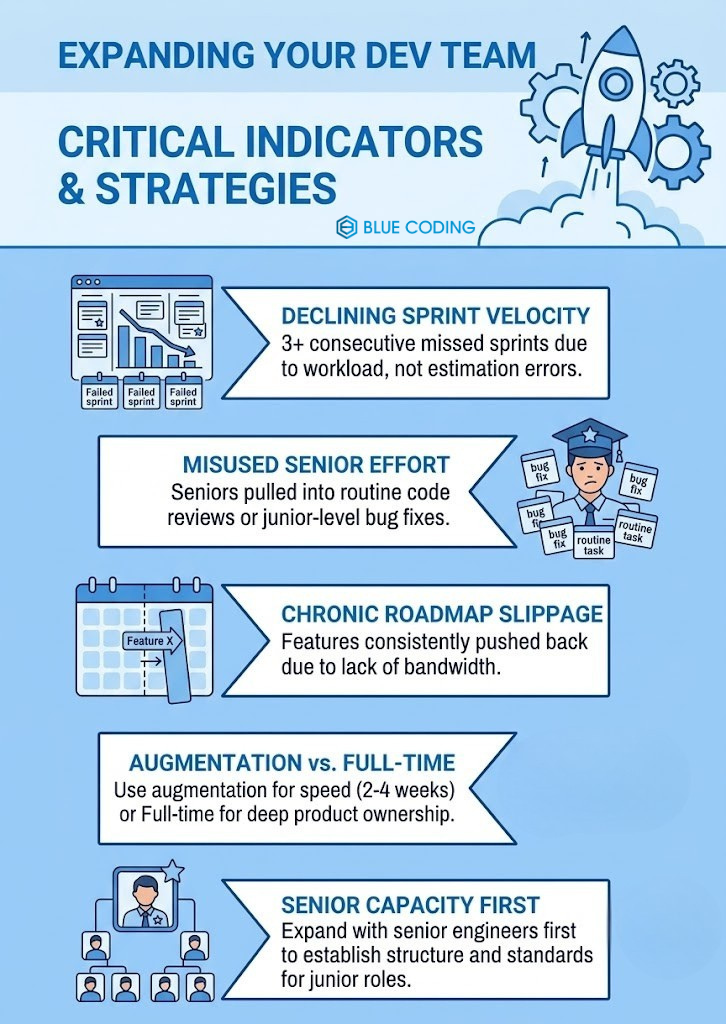
The pattern worth acting on is three or more consecutive sprints where the team is consistently unable to complete what they committed to at planning, where the incomplete work is not a result of poor estimation but a result of the total workload exceeding what the team can realistically absorb. That pattern is not a sprint problem. It is a capacity problem, and more planning meetings will not solve it.
One of the clearest developer hiring milestones is when your senior engineers are consistently pulled into work that should not require their level of experience. Routine code reviews backed up because there are not enough reviewers. Junior-level bug fixes are handled by seniors because nobody else has the bandwidth. Architecture decisions deferred because the engineer who should own them is too deep in delivery work to surface.
This pattern has a double cost. Senior engineering time is your most expensive capacity and it is being spent on the wrong work. And the junior and mid-level engineers who should be developing through those experiences are not getting them, which slows the long-term capability growth of the team. Expansion that brings in the right seniority balance resolves both problems simultaneously.
Roadmap slippage that happens once is a planning issue. Roadmap slippage that happens every quarter is a capacity issue. When features that were scoped and scheduled keep getting pushed to the next quarter not because requirements changed but because the team did not have the bandwidth to get to them, the roadmap is telling you something the headcount planning conversation has not yet addressed.
The cost of chronic roadmap slippage is not just the delayed features. It is the accumulated business cost of those features not being in the market, the credibility cost of consistently missing commitments to stakeholders, and the morale cost to engineers who are working hard and still feel like they are never catching up.
Full-time hiring is the right expansion model when the capacity need is permanent, the role requires deep long-term product context, or you are building a function that does not exist yet and needs an owner who will grow with it over years. Roles like technical lead, platform owner, or founding engineer in a new product area belong in the permanent team.
The limitation is timeline. A senior engineering hire through traditional recruiting takes three to five months from job posting to active contribution. For a capacity need that exists right now, that timeline produces a January solution to an October problem. Software developer staff augmentation from a partner with a pre-vetted bench compresses that timeline to two to four weeks, which changes what is actually solvable within the quarter.
The practical differences between augmentation and temporary hiring, and why the distinction matters for long-term team health, are covered in detail in this comparison of staff augmentation versus temporary hiring.
Software developer staff augmentation solves the gap between when you need capacity and when traditional hiring can deliver it. Engineers from a nearshore partner with an established bench are pre-vetted for both technical skill and communication quality. They embed into your team, work inside your sprint cadence, and contribute to your codebase from the first week rather than spending three months going through an HR onboarding process.
The right use cases for augmentation are defined capacity needs with a known timeline, specific skill gaps the current team does not cover, parallel workstreams that would otherwise require sequencing, and deadline-driven product work that cannot wait for a traditional hiring cycle. For all of these scenarios, augmentation provides the capacity where and when the roadmap actually needs it.
A growing number of US tech companies, including several you would recognize, have made staff augmentation a core part of how they manage engineering capacity. The pattern of why and how they do it is documented across the companies leading the shift.
The most common mistake in tech talent capacity planning is sizing the team for the current backlog rather than the roadmap. The current backlog reflects where the product is. The roadmap reflects where the business needs it to go. A team sized for today's scope is under-resourced for tomorrow's scope before the new quarter even begins.
Effective capacity planning maps backward from roadmap milestones to identify when specific technical capabilities need to be in place and what team configuration is required to hit each milestone. That backward mapping consistently reveals that the decision to expand needs to happen earlier than gut instinct suggests, because the lead time between deciding to hire and having engineers contributing at full velocity is rarely as short as the pressure makes it feel.
When expanding an engineering team, the highest-leverage additions are almost always at the senior or specialist level rather than at the junior level. Adding junior engineers to an over-capacity team without sufficient senior engineering time to mentor and review them does not increase velocity. It decreases it, because the senior engineers who are already stretched now have to absorb the overhead of supporting new junior team members.
The expansion sequence that produces the fastest improvement in delivery velocity is senior capacity first, then mid-level capacity to execute within the systems and standards that senior engineers have established, then junior capacity once the team has the structure to support it. Reversing that sequence is one of the most reliable ways to spend money on team expansion without seeing improvement in output.
For teams evaluating which expansion path makes the most sense given their current setup, the key factors to assess when choosing a software developer staff augmentation provider are laid out in this practical evaluation guide.
The clearest signs are three or more consecutive sprints of declining velocity without a scope-related cause, senior engineers consistently doing work that should be handled at a lower level, and roadmap features being pushed every quarter not because priorities changed but because the team lacks the bandwidth to execute on schedule.
With a nearshore staff augmentation partner that has a pre-vetted bench, the timeline from decision to active contribution is typically two to four weeks. This compares to three to five months for a traditional full-time hire through domestic recruiting, which makes augmentation the practical choice when the capacity need exists within the current quarter.
The answer depends on the nature of the capacity need. Roles requiring deep long-term product ownership, architectural leadership, or foundational team culture belong in permanent headcount. Roles tied to a specific initiative, a defined timeline, or a skill gap that does not exist on the current team are strong candidates for staff augmentation. Most high-performing engineering teams use a combination of both rather than treating the choice as binary.
Senior engineers first. Adding junior capacity to a team that is already over-stretched without sufficient senior oversight increases coordination overhead rather than delivery velocity. Expand at the senior or specialist level first to establish the technical leadership and standards that allow mid-level and junior additions to contribute productively.
Blue Coding connects US engineering teams with senior, English-proficient developers from Latin America who are pre-vetted, immediately available, and ready to integrate into your team from week one. Whether you need one engineer to fill a specific skill gap or a full pod to execute a parallel workstream, we match the capacity to the actual need. We offer a free first call with no commitment. A direct conversation about where your team is running out of runway and how nearshore staff augmentation can give you the capacity to keep the roadmap on track. Book your free call with Blue Coding now to begin your journey towards further success!


Subscribe to our blog and get the latest articles, insights, and industry updates delivered straight to your inbox