Run an effective tech stack review. Use our clear keep, replace, or upgrade framework to manage technical debt and build a seamless legacy migration strategy.



Most engineering teams know their technical debt is a problem long before they do anything about it. The systems that need attention are not a mystery. What is missing is usually a clear framework for deciding which ones to fix, which ones to replace, and which ones to leave alone. A tech stack review is not a single conversation. It is a structured assessment of your entire infrastructure against the demands your product is going to place on it over the next one to three years. Done well, it gives you a prioritized action plan that separates the technical debt worth addressing from the background noise that can wait.
This post is a practical guide to running that assessment, making the keep, replace, or upgrade decision for each component, and thinking about how to resource the work that follows. According to Stripe's Developer Coefficient report, developers spend an average of 33 percent of their time dealing with technical debt, which translates to roughly 85 million developer hours lost globally every year. For most engineering teams, the cost of unaddressed technical debt is not a future risk. It is an active drain on current delivery velocity.
Tech stack reviews stall because they surface decisions that nobody wants to own. Acknowledging that a core system needs to be rebuilt means acknowledging the cost, the timeline, and the disruption that comes with it. It means having conversations with leadership about why the current architecture is limiting the roadmap. It means making a case for engineering investment that does not ship a visible feature. The teams that get through this stall are the ones that frame the review as a risk assessment rather than a criticism of past decisions. Every architecture made sense at the time it was built. The question is whether it still makes sense for where the product is going, not whether it was wrong to build it the way you did.
Not all technical debt carries the same weight. Technical debt that slows development but does not threaten reliability is a productivity problem. Technical debt that creates security vulnerabilities, availability risks, or scalability ceilings is a business risk.
The framework for a tech stack review should distinguish between these two categories from the start. Business risk debt gets prioritized regardless of complexity. Productivity debt gets prioritized based on impact on delivery velocity and the cost of continuing to work around it versus addressing it directly. For a detailed look at when it makes sense to refactor versus when a full rebuild is warranted, Blue Coding's post on when to refactor vs when to rebuild your tech stack covers the decision criteria in detail.
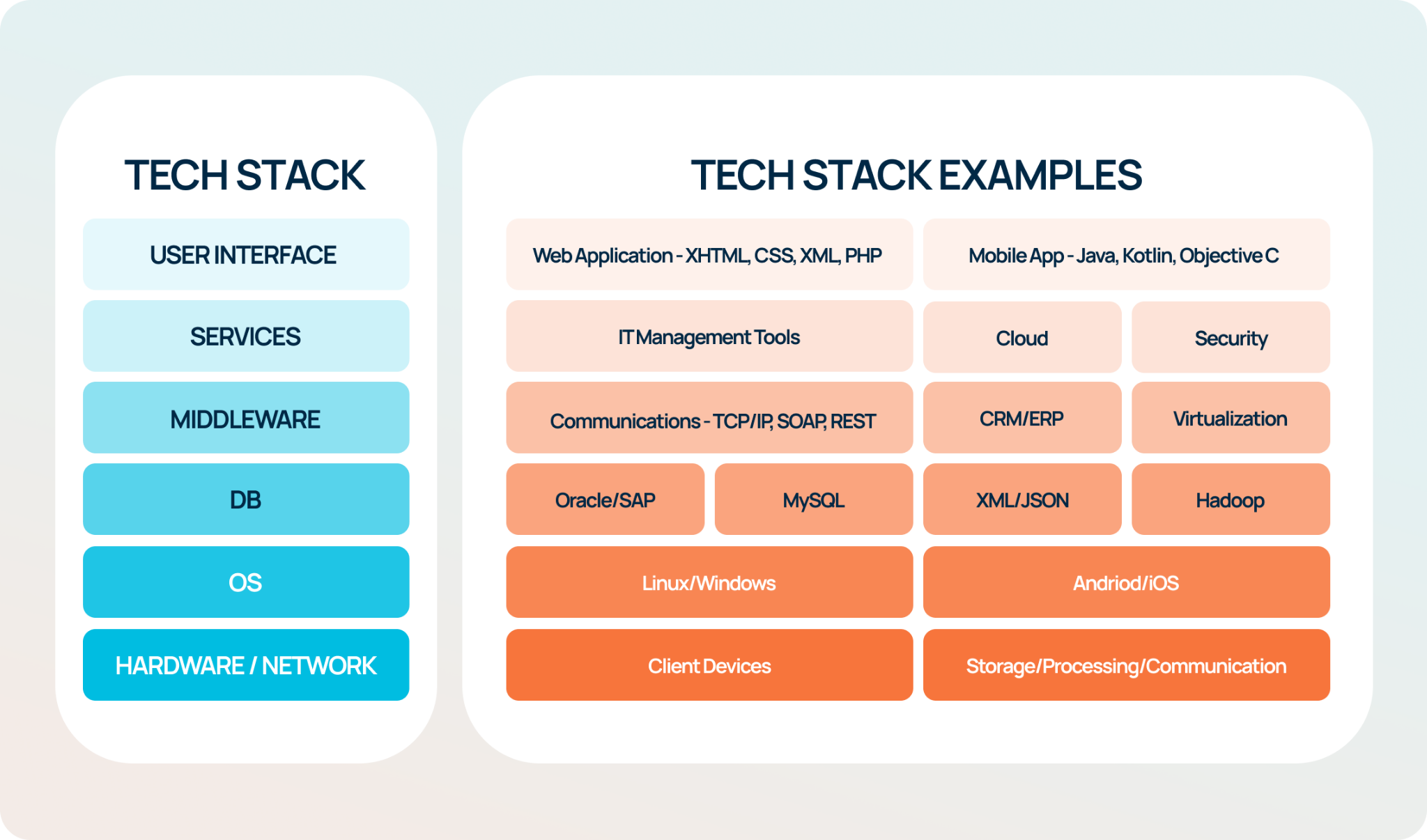
A component earns a keep decision when it is performing reliably, scaling adequately for the next one to two years of product growth, and not creating significant friction for the engineers working with it. Keep decisions are not permanent. They are a judgment that the cost of addressing this now is higher than the cost of leaving it for a future review. The risk with keeping decisions is treating them as default answers. Every component that does not get explicitly evaluated ends up in an implied keep bucket that never gets reviewed. A structured tech stack assessment forces an explicit decision for each component, which means the keep pile is a deliberate choice rather than a collection of things nobody got around to.
Upgrade decisions apply to components that are fundamentally sound but running on outdated versions, operating without security patches, or missing capabilities that would meaningfully improve developer experience or system reliability. The underlying architecture is right. The implementation needs attention.
Infrastructure cost optimization is often a driver here. Cloud configurations, database versions, caching layers, and deployment pipelines that were set up years ago and never revisited frequently carry costs that a modern configuration would reduce significantly. An upgrade in these areas is not just a technical improvement. It is a budget efficiency that funds other priorities. The sequencing of upgrade work matters. Upgrades that are prerequisites for other roadmap work should be prioritized over standalone improvements that improve quality without unblocking anything. Dependency mapping is the most important step in turning a list of upgrade candidates into a sequenced plan.
Replacement decisions are the hardest and the most consequential. A replacement is warranted when the current architecture is actively constraining delivery, when the cost of continuing to work around it exceeds the cost of replacing it, or when the system carries risk that cannot be adequately mitigated without a rebuild.
Legacy migration strategy matters enormously here. Big-bang replacements, where you build a new system and cut over from the old one, carry enormous risk for systems that are actively serving production traffic. The more reliable approach for most teams is a strangler fig migration, where you incrementally replace components of the legacy system while keeping it running until the new version has absorbed its function entirely.
This approach takes longer but produces far more predictable outcomes and allows the team to learn about edge cases and integration points gradually rather than discovering them all at once during a high-stakes cutover. For teams managing legacy system modernization alongside ongoing product delivery, Blue Coding's post on modernizing IT pipelines for rapid software deployment covers how to structure that work without derailing current delivery commitments.
A tech stack review without clear ownership becomes a committee exercise that produces a document nobody acts on. Before the assessment begins, each major component of the stack should have a named owner who is responsible for completing that evaluation and making a recommendation. The recommendations get reviewed together. The ownership is individual.
This matters especially in distributed teams where different engineers have different levels of familiarity with different parts of the system. The engineer closest to a component is almost always the most qualified to assess it, but they need explicit permission and protected time to do the work rather than squeezing it in around delivery commitments.
One of the most common mistakes in technical debt assessment is prioritizing by severity without sizing the effort. A high-severity item that would take six months to address with current team capacity needs to be evaluated differently than a high-severity item that a focused engineer could resolve in two weeks. A rough effort estimate for each recommended action, even a T-shirt sizing exercise that produces small, medium, large, and extra-large categories, gives you the information you need to sequence work based on impact-to-effort ratio rather than just impact alone. The items with the highest ratio are your starting point.
The output of a tech stack review is almost always a workload that the existing team cannot absorb alongside its current delivery commitments. That is not a reason to defer the work. It is a reason to plan for the additional engineering capacity required to execute it. Modern tech stack transitions and legacy migration projects benefit significantly from nearshore staff augmentation. Engineers who specialize in migration work, infrastructure modernization, or specific legacy technologies can be brought in for the duration of the project without permanent headcount implications. The work gets done, the debt gets addressed, and the core team maintains delivery velocity on the product roadmap in parallel. For a look at how long-term engineering partnerships compare to project-based approaches for this kind of sustained technical work, Blue Coding's post on why long-term software teams outperform project-based outsourcing is worth reading before you plan the resourcing side of a major migration.
The McKinsey Technology Council estimates that technical debt consumes between 10 and 20 percent of technology budgets, with some organizations seeing that figure climb above 40 percent in heavily accumulated cases. That is the budget being spent maintaining systems that should be replaced rather than building systems that move the product forward.
A structured tech stack review with a clear keep, replace, or upgrade framework is how you stop that accumulation from compounding into a situation that requires a full platform rebuild. The sooner you run the assessment, the more options you have for addressing what it surfaces.
Blue Coding is a nearshore software development and tech staff augmentation company that helps US engineering teams plan and execute technical debt reduction, infrastructure modernization, and modern tech stack transitions with senior, pre-vetted engineers from Latin America. We offer a free first call, which you can book now, with no commitment. A direct conversation about what your stack assessment has surfaced and whether the right nearshore engineering capacity can help you address it faster than your current team headcount allows.


Subscribe to our blog and get the latest articles, insights, and industry updates delivered straight to your inbox