Don't let your Q4 software budget expire. Learn why locking in a nearshore development partner before year-end is the ultimate cost optimization strategy.



Most software budget decisions look rational on a spreadsheet. In practice, they are driven by deadlines that have nothing to do with technical readiness and everything to do with how annual budgets work. Q4 is the moment when engineering leaders who have been putting off vendor decisions all year suddenly find they have a budget that needs to be committed before January. That urgency, combined with the real cost of starting a new year without the engineering capacity to execute the roadmap, is why nearshore development partnerships are almost always initiated in the final quarter.
This post explains the mechanics behind that pattern, why it makes strategic sense, and how to approach year-end nearshore cost optimization so you are getting genuine value from the timing rather than just spending budget for the sake of it. According to Gartner's global IT spending forecast, worldwide IT spending is projected to grow 9.3 percent in 2025, with software and IT services accounting for the largest share of that growth. The companies capturing the most value from that spending are the ones making vendor decisions early enough to get engineers productive before the new year begins, not after.
Annual software budgets create a rhythm that most engineering leaders work around but rarely talk about explicitly. Budget that is allocated to engineering capacity but not committed by year-end either rolls back to finance or gets reallocated to other priorities. That creates a genuine incentive to initiate vendor engagements in Q4 even if the full onboarding does not happen until January.
The smarter version of this is not just committing a budget before a deadline. It is using the Q4 window to do the vendor selection, vetting, and contracting work so that engineers can start contributing in the first or second week of January rather than waiting until March after a rushed hiring process in the new year. Companies that treat year-end as a planning and commitment window rather than a scramble consistently outperform the ones that wait until January with an empty roadmap and a gap where engineering capacity should be.
The real cost of not locking in a nearshore development partner before year-end is not the missed budget. It is the January and February delay that follows. A company that enters Q1 without the engineering capacity its roadmap requires does not catch up quickly. The first sprint of the new year sets the pace for the quarter, and a slow start compounds into a missed Q1 milestone that pushes timelines well into the second half of the year.
By contrast, a company that enters January with a nearshore partner already vetted, contracted, and oriented can have engineers contributing to sprint velocity from the first week. That head start is worth considerably more than whatever discount or delay might come from waiting for the new year to begin vendor conversations. For more on why Q4 is consistently the most strategic window for hiring engineering capacity, Blue Coding's post on why hiring software developers in Q4 beats waiting until the new year covers the timing dynamics in detail.
One of the reasons nearshore development partnerships fit the Q4 window well is that the vendor selection process is faster than most companies expect. A structured evaluation of a nearshore partner, covering vetting process quality, communication standards, bench availability, and contract terms, can typically be completed in two to three weeks with the right partner. That means a company that starts a nearshore evaluation in early November can have a contract signed, engineers selected, and onboarding scheduled before the holiday slowdown. The first full sprint of January starts with capacity already in place rather than a job posting that goes live on January 2nd and produces a hire in April.
Traditional full-time hiring cannot compete with this timeline. Neither can offshore arrangements that require longer due diligence around time zone management, communication protocols, and quality assurance. The combination of nearshore speed and the Q4 budget window is one of the clearest cases for why this model has grown so consistently among mid-market and growth-stage US tech companies.
For engineering leaders making the case to finance and executive leadership, nearshore cost optimization is one of the most concrete arguments available. Senior engineers in major US tech markets command total compensation packages of 150,000 to 200,000 dollars or more per year. Equivalent senior engineering talent through a nearshore development partner in Latin America typically costs 40 to 60 percent less, with no reduction in output quality.
When you are forecasting a software budget for the coming year, the difference between building engineering capacity domestically and building it nearshore is significant enough to affect what you can afford to build. A team that would require five US-based hires at full compensation can potentially be eight or nine engineers at the same budget through a nearshore partnership, with time zone alignment and English communication that makes the model genuinely effective rather than just cost-efficient on paper. For a detailed breakdown of how nearshore development compares to in-house costs across different team configurations, Blue Coding's post on how hiring LATAM developers helps reduce IT costs covers the actual numbers.
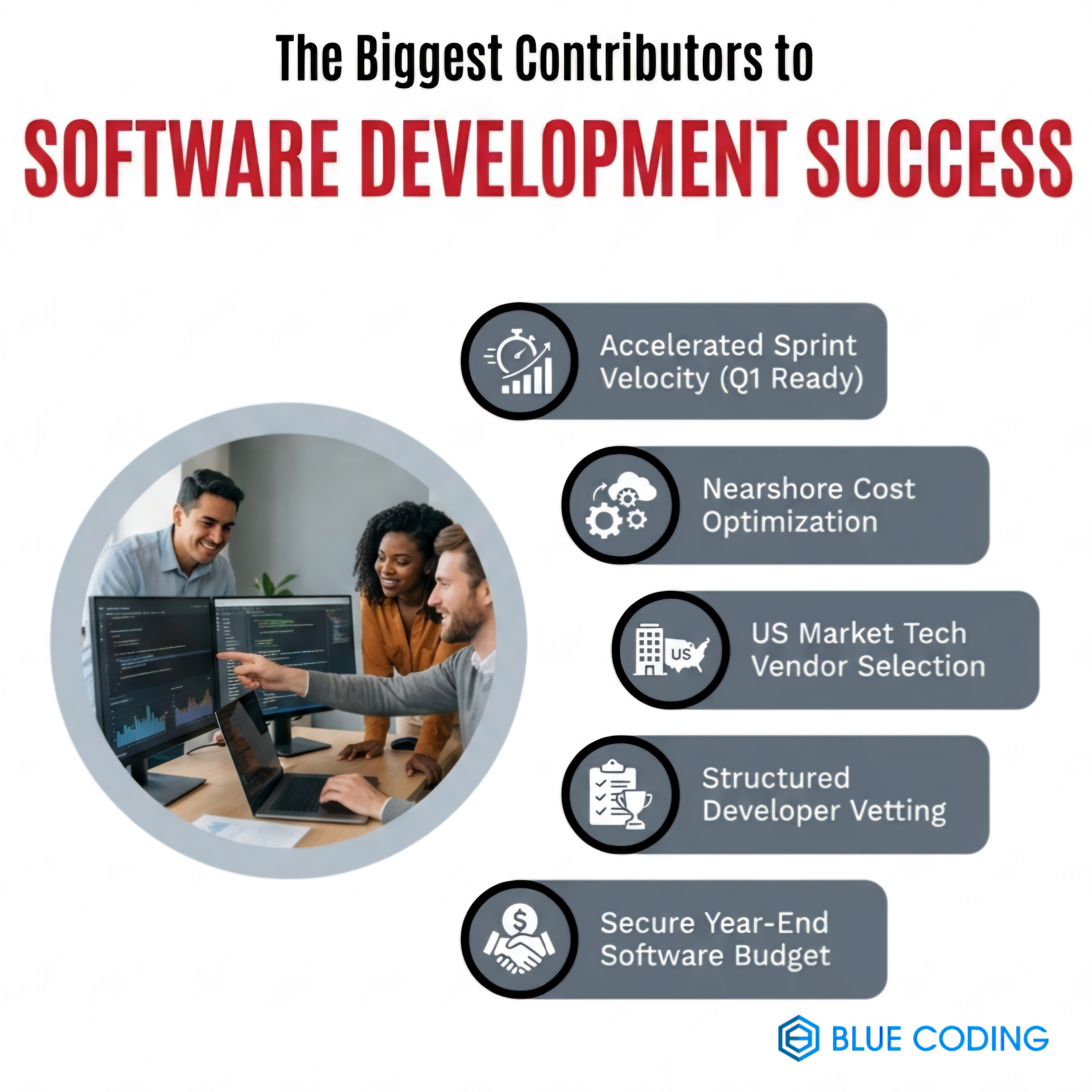
The risk of Q4 vendor decisions is that budget pressure creates the wrong kind of urgency. Companies commit to a nearshore partner based on a sales conversation and a polished pitch deck rather than a structured evaluation of what the partner actually delivers. That shortcut produces outcomes that confirm every skeptic's concern about nearshore development, not because the model does not work but because the partner selection process did not do the work that partner selection requires.
Before you commit budget to a nearshore development partner at year-end, the questions worth asking directly are: what does your technical vetting process look like end to end, how do you assess English communication quality, what is your replacement process if an engineer is not the right fit, how quickly can you staff against our specific requirements, and what does ongoing support look like after placement? A partner with confident, specific answers to all of those is worth the Q4 commitment. A partner who is vague on any of them is a risk you do not want to carry into a new year with a fresh roadmap.
The companies that get the most out of a Q4 nearshore commitment use the period between signing and January for more than paperwork. They introduce the incoming engineers to the team, share codebase documentation, provide product context, and run an abbreviated onboarding process before the first sprint begins. Engineers who arrive in January with two weeks of context under their belt contribute at a meaningfully different level in their first sprint than engineers who are getting oriented while the team is already running. That pre-onboarding investment, made possible precisely because Q4 vendor decisions create the runway for it, is one of the most underused advantages of locking in a nearshore partnership before year-end.
The best nearshore development partner conversations in Q4 are not just about filling specific open roles. They are about understanding what the engineering roadmap looks like for the next twelve months and building a staffing strategy that matches it. That means being honest about where the current team has skill gaps that are constraining velocity, where the roadmap is going to require new technical capabilities that do not exist in-house, and where the capacity needs are likely to flex over the course of the year. A nearshore partner who understands your roadmap can build a relationship structure that adjusts as your needs evolve rather than locking you into a fixed configuration from day one. For a practical guide to building a nearshore development team that is sized and structured to match your actual budget and technical requirements, Blue Coding's post on building a nearshore dev team according to your budget is worth reading before your Q4 vendor conversations begin.
According to Deloitte's Global Outsourcing Survey, 70 percent of companies pursue outsourcing arrangements primarily for speed to capability. The ones doing it in Q4 are not just saving budget. They are buying a head start on a year where the companies that begin January with full engineering capacity will move faster than the ones still hiring in March. The year-end window is real, the budget logic is sound, and the operational advantage of entering Q1 with a nearshore partnership already running is significant. The only variable is whether you start the conversation early enough to capture it.
Blue Coding is a nearshore software development and tech staff augmentation company that helps US businesses lock in engineering capacity before year-end and enter Q1 with developers who are already contributing. We work with companies across every major US tech market to match them with senior, English-proficient engineers from Latin America who are pre-vetted, immediately available, and ready to integrate from week one.
If you have a budget to commit before year-end and a roadmap that needs engineering capacity in January, the conversation worth having is now, not in February when everyone else is starting their searches. We offer a free first call with no commitment. A direct conversation about your Q4 timeline, your engineering needs, and whether we are the right partner to help you start the new year with the team you actually need. What are you waiting for? Book your free call with Blue Coding today!


Subscribe to our blog and get the latest articles, insights, and industry updates delivered straight to your inbox