Keeping remote engineers productive takes more than good tools. Discover the management strategies that high-performing distributed teams actually use.


.svg)
.svg)
By 2027, an estimated 86% of the global workforce will include at least some remote workers and for software development teams, that number is already far beyond that. Remote engineering is no longer a contingency plan. It’s the standard. But keeping those teams productive? That part hasn’t gotten easier just because remote work became normal. Distance doesn’t have to mean disconnection. It doesn’t have to mean missed deadlines, slow feedback loops, or developers working in silos. But if you don’t build the right structure, those things will happen on their own. The good news is that keeping a remote engineering team performing at a high level is very doable when you focus on the right areas.
One of the biggest traps remote engineering managers fall into is expecting their team to be online and responsive at all times. The logic makes sense on the surface if everyone’s available, nothing gets blocked. But in reality, constant interruptions are one of the fastest ways to kill deep work. Developers need focused blocks of time. A senior engineer troubleshooting a complex API issue or reviewing a pull request needs two to three hours of uninterrupted concentration. Pinging them every 30 minutes for status updates costs more than it gains.
The shift to asynchronous communication doesn’t mean slowing things down. In fact, it means being intentional about when real-time interaction is actually necessary. Tools like Loom, Notion, and threaded Slack channels let engineers update each other without disrupting flow states. Stand-ups don’t need to happen live every day. A written async check-in can cover the same ground in a fraction of the time.
Define where different conversations happen. Bug reports live in Jira. Design decisions get documented in Confluence or Notion. Quick questions go to Slack. Code review happens in GitHub. When everything has a home, engineers stop digging through threads to find context and spend that time building instead. This is especially valuable for nearshore and distributed teams working across different time zones. Clear channels mean a developer in Colombia doesn’t need to wait for their US-based manager to wake up before they can move forward on a task.
A lot of companies track hours logged or tickets closed. These numbers are easy to pull, but they often tell you very little about whether a team is actually productive. A developer can close 20 tickets in a week and still be a net negative if they’re shipping brittle code that creates five more tickets next week.
Software development KPIs worth tracking include:
• Cycle time: How long does it take a feature to go from start to shipped? Shorter is better, but not at the cost of quality.
• Deployment frequency: How often is working code being released? High-performing teams deploy frequently and safely.
• Change failure rate: What percentage of releases cause a problem that requires rollback or hotfix?
• Code review turnaround: How quickly are pull requests getting reviewed? Stalled reviews block the whole team.
These are the kinds of metrics that show you whether your team is actually building well, not just staying busy.
KPIs shouldn’t just be something managers look at. When developers can see how their work connects to the bigger picture and where they’re performing well or have room to grow, they become more self-directed. That’s a quality you want in any remote team. Weekly or bi-weekly one-on-ones are a good place to review performance in a low-pressure way. Make it a conversation, not a performance review. The goal is to remove blockers and support growth, not just audit output.
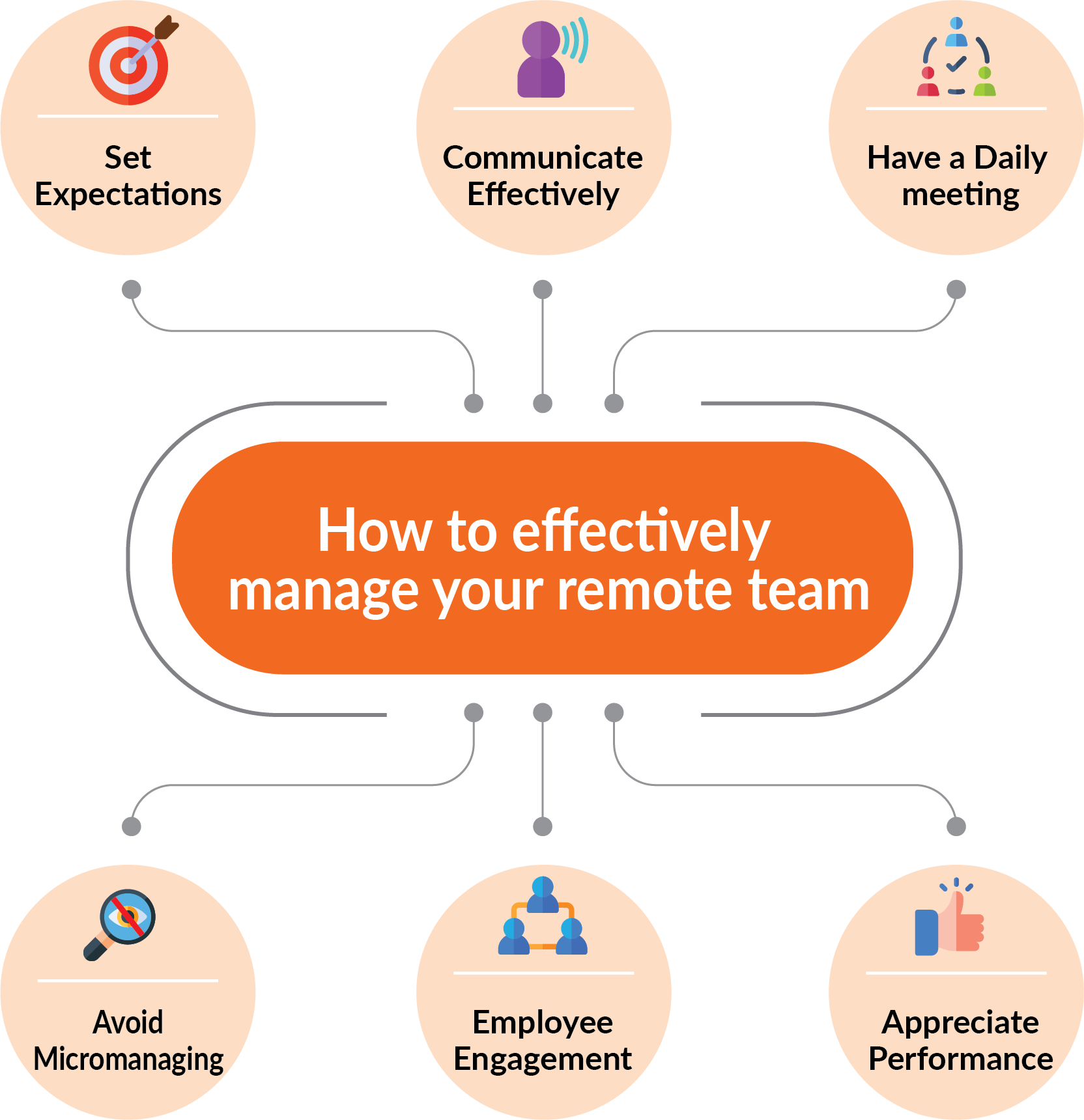
When your team shares the same office, a lot of knowledge travels through hallway conversations, shoulder taps, and whiteboard sessions. None of that exists in a remote team. If it isn’t written down, it doesn’t exist. Strong remote engineering teams treat documentation as a first-class practice, not an afterthought. Decision logs, architectural notes, onboarding guides, runbooks; these are what keep a distributed team aligned even when people are offline. It also dramatically reduces the time new team members spend getting up to speed.
Remote doesn’t have to mean isolated. Teams that stay productive over the long run usually have some shared rituals that create a sense of belonging. This might be a weekly team channel where people share something non-work related, a monthly team quiz, or just celebrating shipped features publicly.
These things sound small, but they matter enormously for retention. Developers who feel connected to their team and their work stick around. High turnover is one of the most destructive forces for remote engineering productivity, and culture is your best defense against it. According to research from Gallup, teams with strong engagement see 23% higher profitability. Engagement doesn’t happen by accident on a remote team—it requires intentional effort from leadership.
One of the challenges many US companies face with offshore development is the time zone gap. When your engineering team is 10 or 12 hours ahead, collaboration windows shrink to almost nothing. Async communication helps, but some things genuinely need real-time conversation: sprint planning, design reviews, incident response.
Nearshore engineering teams, particularly from Latin America, solve this problem at the root. LATAM developers typically work within one to three hours of US time zones, which means your teams can run standups, answer questions live, and ship together without anyone having to work unusual hours. This time zone alignment is one of the most underrated factors in remote engineering productivity. It removes the friction that offshore models build in by default.
Even the best developer will underperform if they don’t know what’s expected of them or can’t access the tools they need. A strong onboarding process for remote engineers should cover not just technical access and setup, but also communication norms, how decisions get made, what good work looks like on your team, and who to go to for what. The first few weeks of a developer’s experience shape how they’ll work for the next few years. Treat that onboarding window as an investment, not a checklist.
Most engineering teams run sprint retrospectives, but a lot of them are treated as formalities. The real value of a retro is in identifying what’s slowing the team down and actually changing it. If the same issues come up every two weeks and nothing changes, the team stops trusting the process.
Make retros action-oriented. Every identified problem should have a clear owner and a clear next step. Track whether changes made in previous retros actually helped. Over time, this continuous improvement loop compounds into significantly better team performance.
Tool sprawl is a real problem for remote teams. When you have five different project management systems, three communication tools, and no clear decision about which one to use for what, engineers spend more time navigating their environment than doing actual work.
Audit your tooling regularly. Does it serve the team’s workflow, or have you just accumulated tools over time? Fewer, better-integrated tools almost always outperform a scattered stack. Harvard Business Review research shows that clear structure and reduced cognitive load are among the top drivers of remote worker output.
At Blue Coding, we’ve been connecting US companies with world-class nearshore engineering talent from Latin America since 2014. We understand that finding the right developers is only part of the equation, the rest is building the structure that lets them do their best work.
If you’re planning to scale a development team from scratch or looking to fill critical technical gaps, we match you with vetted LATAM engineers who communicate clearly, work in your time zone, and integrate smoothly into your existing workflow. Ready to build a remote engineering team that actually performs? Book your free first call with Blue Coding today and let’s talk about what’s possible.


Subscribe to our blog and get the latest articles, insights, and industry updates delivered straight to your inbox