Ready to go global? Discover how global software teams are helping tech leaders find the best talent. This CTO guide explores the benefits and tactics of managing a borderless engineering team effectively.


.svg)
.svg)
The era of the office-first tech stack has officially come to an end. If you are a CTO today, your primary challenge is no longer just choosing between React or Vue or deciding when to migrate to a microservices architecture. Instead, your biggest hurdle is figuring out how to scale your engineering capacity without being restricted by the physical location of your headquarters. Building borderless engineering teams is not just a passing trend. It has become a competitive necessity for any tech-driven company that wants to survive in a fast-paced market. In this comprehensive guide, we are going to look at the CTO strategy required to move past the old outsourcing mindset and build a high-performing, unified global organization.
For many years, tech leaders viewed offshore hiring as a simple cost-cutting measure. You would hire a development shop to handle the repetitive tasks while your core team did the heavy lifting and strategic thinking. That model is now fundamentally broken. It creates silos, breeds resentment, and inevitably leads to massive amounts of technical debt.
A truly borderless approach treats every engineer as a core team member, regardless of their zip code. When you tap into global software teams, you are not just saving on overhead costs. You are accessing the top one percent of talent in emerging hubs like Latin America, Eastern Europe, and Southeast Asia. These are regions filled with highly skilled developers who are often more motivated and loyal than those in hyper-competitive markets like San Francisco or London.
When you commit to borderless engineering teams, you gain several strategic advantages. First, you get follow-the-sun productivity. While your local team in the United States is sleeping, your engineers in Poland or Argentina are pushing code and fixing bugs. This leads to a continuous development cycle that can significantly shorten your time-to-market.
Second, you see a major improvement in retention. Engineers in emerging markets are often looking for long-term stability and the chance to work on high-impact global products. By offering competitive international pay and a path for career growth, you become an employer of choice in these regions.
Finally, there is the benefit of cultural diversity. Different perspectives lead to more robust problem-solving and better user experiences for a global customer base. A developer in Medellin might see a UX friction point that a developer in Seattle would completely overlook.
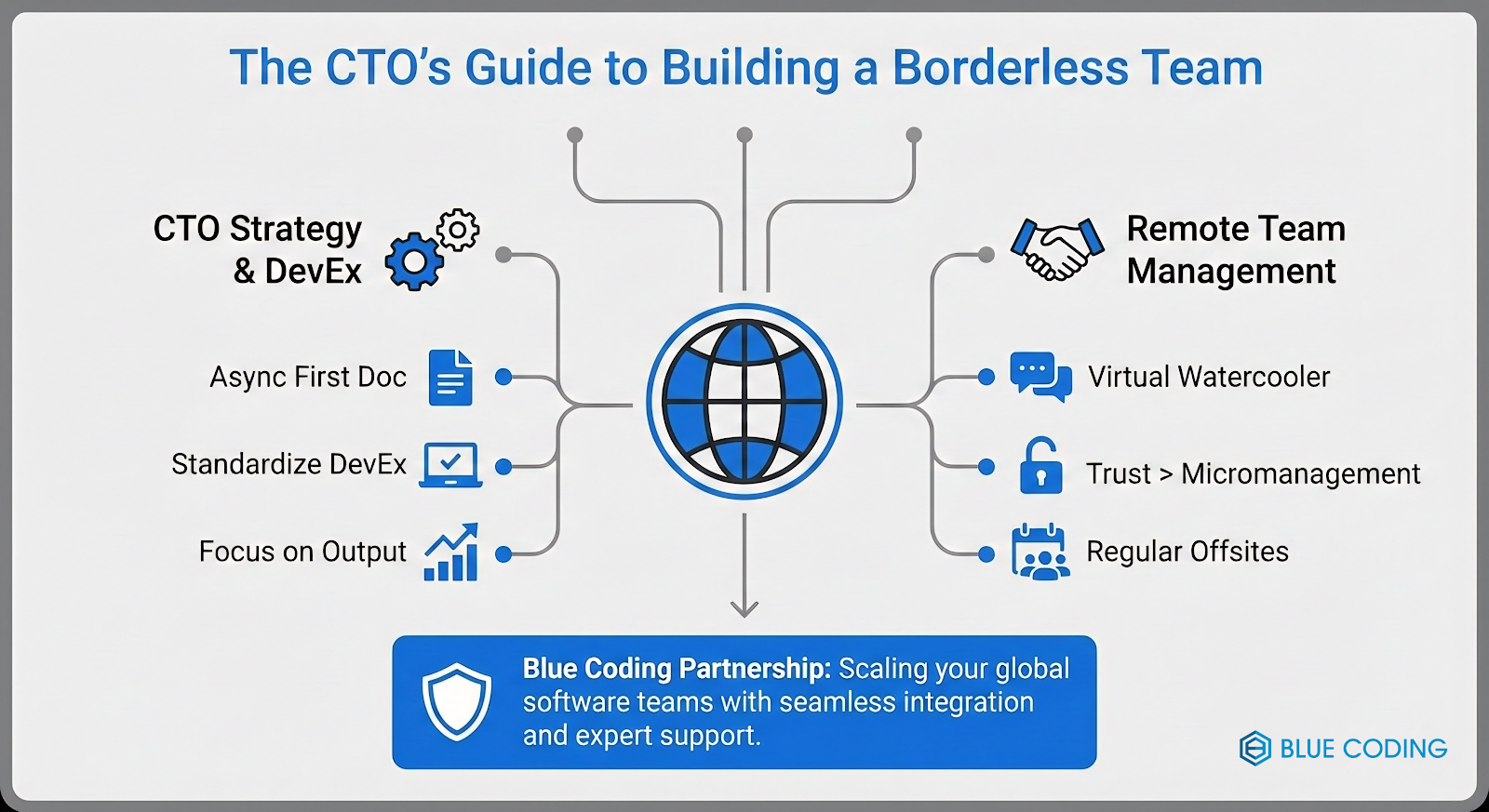
As a CTO, you treat your software architecture with extreme precision. You should apply that same systems thinking to your team structure. You cannot just hire five people in Brazil, give them a Jira login, and hope for the best. You need a deliberate plan.
One of the most important parts of a successful CTO strategy is shifting to asynchronous communication. Synchronous communication, which usually means constant meetings and real-time messaging, is the enemy of global software teams. If your company culture relies on quick chats in the hallway or unscheduled video calls, your remote team members will quickly feel like second-class citizens.
To fix this, you must adopt a documentation-first mindset. If a decision is made, it must be recorded in a shared space like Notion or GitHub. Every meeting should be recorded for those in different time zones. You should also aim for a 4-hour overlap between your primary time zones. This window is dedicated to pair programming, complex architectural reviews, and team building. Outside of those four hours, the expectation should be that work happens independently.
A developer in Buenos Aires should have the exact same onboarding experience and local environment setup as a developer in New York. If it takes three days for a new hire in Europe to get their access permissions while a local hire gets them in three hours, you have already failed.
Standardizing the Developer Experience, or DevEx, is crucial. Use cloud-based development environments to ensure that the phrase it works on my machine is never heard again. By providing a consistent set of tools and automated CI/CD pipelines, you lower the barrier for global talent to contribute meaningful code starting from their first week.
Successful remote team management is twenty percent about the tools you use and eighty percent about the trust you build. Without the visual cue of seeing someone sitting at a desk, some leaders fall into the trap of micromanagement. They start tracking keyboard strokes or demanding that people stay active on Slack all day. This is a death sentence for an engineering culture.
Instead, you must focus on output rather than hours worked. In a borderless environment, presence is measured by pull requests merged, tickets closed, and the overall quality of the code. You need to implement clear KPIs that focus on impact. If an engineer delivers their sprint goals ahead of schedule while working from a beach in Portugal, that should be celebrated, not questioned.
Isolation is the biggest risk for remote engineers. To combat this, you must be intentional about social interaction. You cannot leave it to chance. Do not skip your one-on-one meetings. These sessions should be used for career coaching and pulse checks rather than just status updates on projects.
Create interest-based channels in your messaging apps. Whether the topic is gaming, fitness, or pets, give your people a space to be human and connect over things other than work. Additionally, you should budget for annual or semi-annual offsites. Nothing replaces the value of meeting in person, and those few days of face-to-face interaction can build enough social capital to last for an entire year of remote work.
One of the biggest hurdles in any CTO strategy for global growth is the legal and financial complexity. You have a few main ways to hire. You can work with direct contractors, which is low in complexity and good for short-term projects. However, this doesn't always provide the legal protections or benefits that top-tier talent expects.
The second option is using an Employer of Record, or EOR. This allows you to scale quickly in a specific country without setting up your own legal entity. The EOR handles the local taxes, benefits, and labor law compliance.
The third and often most effective option for high-growth companies is staff augmentation through a trusted partner. This gives you access to vetted talent without the HR headache. At Blue Coding, we have seen that a hybrid approach works best. By leveraging partners who understand the local labor laws, you can focus on building your product while the partner handles the administrative burden.
Just as you can accumulate technical debt by taking shortcuts in your code, you can accumulate culture debt by ignoring the needs of your remote workers. If your global team members are always the ones who have to stay up late for meetings, or if they are excluded from the biggest strategic conversations, your culture will eventually break. Building borderless engineering teams requires you to be a proactive leader. You have to constantly ask for feedback from your international hires. Are the tools working? Do they feel supported? Do they understand the company vision? If you do not ask these questions, you will not find out there is a problem until your best engineers start quitting.
From a business perspective, the move toward remote team management on a global scale is an economic game changer. It allows companies to optimize their burn rate while maintaining a high velocity. You can hire two or three senior engineers in a burgeoning tech hub for the price of one in a major US tech city. This does not mean you are looking for cheap labor. Rather, you are looking for high-value talent in markets where the cost of living allows for more competitive scaling.
This shift also makes your company more resilient. If your entire team is in one city and a natural disaster or local economic crisis hits, your business is at risk. A distributed, borderless team provides a level of stability that a centralized team simply cannot match.
At Blue Coding, we understand the challenges of building and maintaining borderless engineering teams because we have been doing it for years. We know that a successful CTO strategy requires more than just finding people who can code; it involves finding the right cultural and technical fit to ensure long term success. Our team is dedicated to helping you find top tier talent from across the globe while we handle the heavy lifting of recruitment and logistics. We specialize in building global software teams that integrate seamlessly into your existing workflows, making remote team management feel natural and efficient. We are not just a vendor but a partner in scaling your vision. Contact us today to learn how we can help you build your perfect engineering team. We can start with a complimentary strategy call!


Subscribe to our blog and get the latest articles, insights, and industry updates delivered straight to your inbox