Stop losing top talent to slow feedback loops by learning how to optimize your technical interview pipeline and close the best candidates in days instead of weeks.


.svg)
.svg)
Let’s be honest: the traditional developer hiring process is often where good talent goes to die. More accurately, it is where it goes to work for your competitors because they were three days faster than you. In 2026, the tech market moves at the speed of an automated deployment script. If your technical interview pipeline feels more like a 1990s dial-up connection than a fiber-optic stream, you are not just losing time. You are losing the very people who could build your next big thing. Top candidates are usually off the market in about 10 days. If your process takes six weeks, you are essentially interviewing the leftovers. It is time to trim the fat, automate the boring stuff, and get back to what matters: finding great humans who write great code.
Every day a role stays open is a day your product is not shipping features or fixing bugs. But the cost is more than just missed code. It is a massive drain on your existing team. When your senior engineers are stuck in a never-ending loop of interviews that lead nowhere, their morale drops. They start to see the hiring process as a chore rather than an investment. Furthermore, a slow process signals a slow culture. Developers assume that the way you hire is the way you work. If it takes three weeks to get a feedback email, they will assume it takes three months to get a pull request merged. You are building a reputation before the candidate even signs the contract.
You cannot fix what you have not measured. Most companies suffer from the bottleneck effect, where a single senior engineer is the only person allowed to do technical screens. This person is usually busy, hates interviewing, and takes four days to submit feedback. To speed up your technical recruitment efforts, start by mapping out every single touchpoint a candidate has. You need to know exactly where the lag is. Is it the time between the first call and the test? Is it the gap between the test and the final interview? Or is it the five days it takes the executive team to approve the salary?
If you have more than four interview rounds, you are likely over-indexing on certainty and under-indexing on speed. Research shows that the predictive value of interviews drops off significantly after the fourth encounter. You are not getting more certain; you are just getting more tired.
2. Ditch the Resume-First Mentality
Resumes are historical fiction. In 2026, we have moved firmly into the era of skills-based hiring. Instead of spending hours squinting at PDFs to see if someone worked at a big tech company, use technical screening tools to let the code do the talking immediately. By moving a lightweight, job-relevant assessment to the very front of your technical interview pipeline, you filter for competency rather than pedigree. This does not mean sending a four-hour Leetcode marathon. Top developers will ignore those because they have three other offers already. It means a 20-minute day-in-the-life simulation.
This approach saves your recruiters from talking to people who cannot actually code, and it saves your engineers from wasting time on technical screens that should have never happened.
3. Implement Agentic AI Screening
The biggest trend this year is the shift from static tests to agentic AI screening. Modern technical screening tools now use AI agents that can actually talk to candidates in a helpful, interactive way.
These are not the annoying chatbots from five years ago. They are conversational agents that probe a candidate’s conceptual understanding. They can ask questions like: I see you used a microservices architecture here; why did you choose that over a monolith for this specific scale?
This allows you to accomplish three things:
When the AI handles the first layer of technical verification, your engineers only step in when they know the candidate is actually worth the 60 minutes of their time.
4. The One-Day Loop Strategy
Nothing kills candidate momentum like hearing: We will get back to you next week. When you reach the final stages of technical recruitment, try to condense the entire loop into a single day or a 48-hour window. Speed is a feature. The faster the feedback, the higher the offer acceptance rate. Candidates interpret speed as a sign of a high-functioning engineering culture. They want to work at a place that makes decisions and moves forward.
5. Improving the Candidate Experience (CX)
We often forget that an interview is a two-way street. While you are evaluating them, they are evaluating you. A slow, disorganized technical interview pipeline is the fastest way to lose a senior engineer. They want to see that you respect their time. One way to speed things up is to be radical with transparency. Include the salary range in the job description. Mention the tech stack and the specific challenges the team is facing. When you provide all this information upfront, you eliminate the back-and-forth emails that usually take up the first week of the hiring process. Furthermore, give feedback fast. Even if the answer is no, a candidate would much rather hear it in 48 hours than be ghosted for two weeks. A quick no is better for your brand than a slow maybe.
6. Modernize Your Tech Stack (For Hiring)
If your internal tools look like they were designed for a different decade, your candidates will feel it. A slow, clunky application form is the quickest way to see a high drop-off rate. In 2026, your developer hiring process must be mobile-friendly and integrated. Developers often apply for jobs in short bursts. They might see your post on their phone and want to hit a single button to apply. If you require them to create a password and upload a document they don't have on their phone, they will move on.
Ensure your technical screening tools feed directly into your Slack or Discord channels. If a recruiter has to manually download a report and email it to a hiring manager, you have already lost precious hours. The goal is to have the technical results pop up in a shared channel the moment the candidate finishes.
7. Closing the Loop with Speed-to-Offer
The final sprint is often where the wheels fall off. You have found the perfect candidate, but the approval process for the offer letter is stuck in a vice president’s inbox. To win in the world of technical recruitment, you need a pre-approved offer framework.
You should know exactly what you can offer before the first interview even starts. Setting clear salary bands and equity stakes ahead of time allows the recruiter to move immediately once the engineering team gives the green light.
Aim to have an offer letter in the candidate’s inbox within 24 hours of the final interview. By the time they have finished talking to their family about how much they liked your team, the offer should already be waiting for them. This creates a sense of excitement and momentum that is hard to beat.
8. Common Bottlenecks and How to Smash Them
Many companies struggle with what I call the committee trap. This is where everyone on the team has to say yes for a hire to happen. While it sounds democratic, it is actually a recipe for mediocrity and slowness. One person having a bad day can veto a great candidate.
Instead, move to a model where there is one clear decision-maker, usually the hiring manager. Everyone else provides input and data, but the decision rests with one person. This removes the need for endless debrief meetings and allows you to move at a pace that keeps top talent engaged. Another bottleneck is the take-home project. If your project takes more than two hours, you are excluding anyone with a life, a family, or other job offers. If you must use a take-home, pay the candidate for their time. It shows you value them and it dramatically increases the completion rate.
9. Measuring Your Success
Once you have revamped your technical interview pipeline, you need to keep an eye on the metrics that matter.
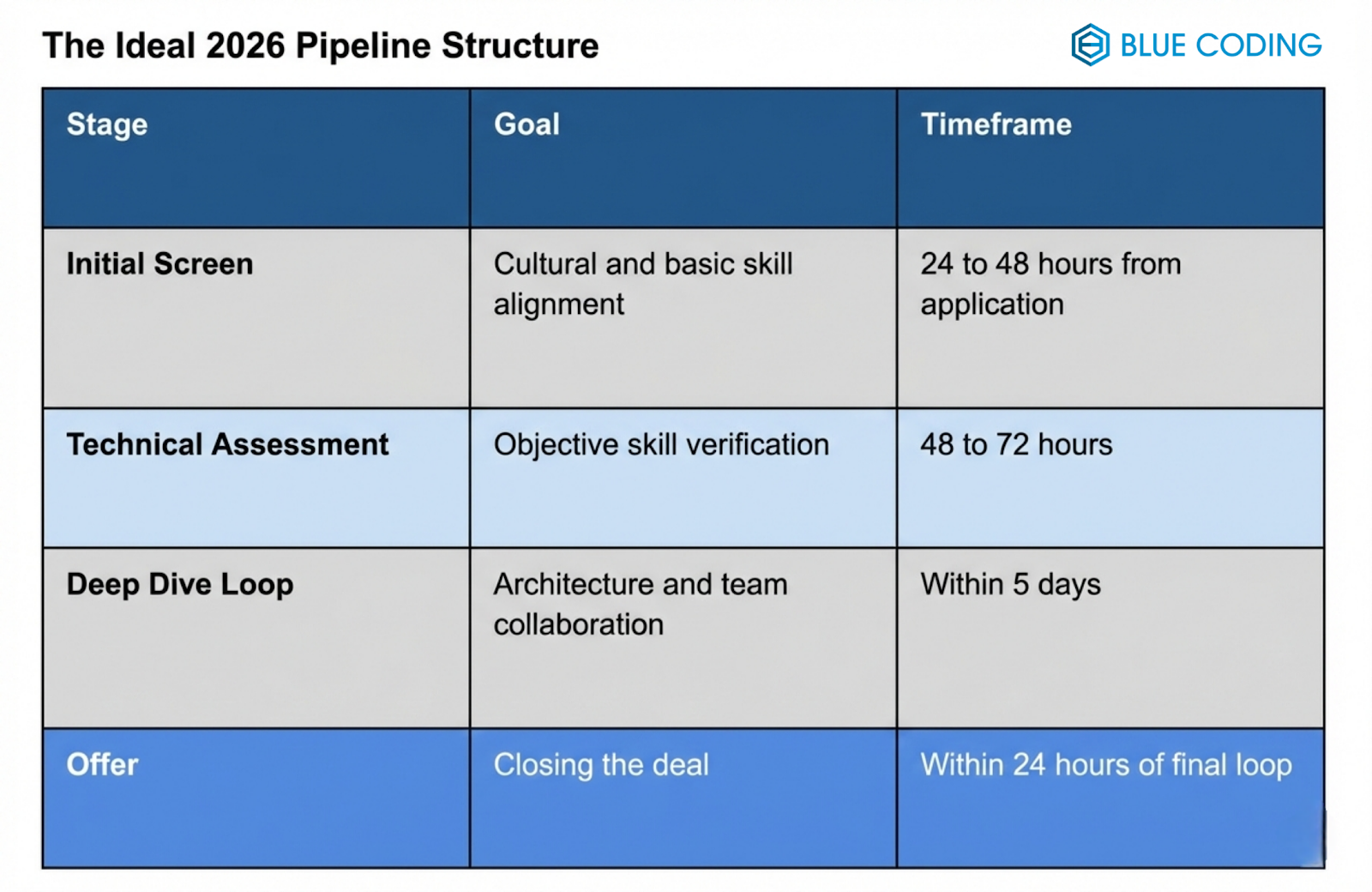
At Blue Coding, we know that an inefficient technical interview pipeline prevents you from hitting your product milestones and staying ahead of the competition. Since our inception, we have dedicated ourselves to refining the technical recruitment experience for both companies and developers. We specialize in identifying the top tier of global talent through a developer hiring process that is as rigorous as it is rapid. By utilizing the latest technical screening tools and a human centric approach, we mirror the efficiency of the Ideal 2026 Pipeline Structure shown in the image above. Contact us today to discover how our tailored hiring solutions can help you secure the engineering talent you need to grow. We also offer an initial complimentary strategy call!


Subscribe to our blog and get the latest articles, insights, and industry updates delivered straight to your inbox