Don't wait for the technology to mature before you act. Find out why starting your AI journey now allows you to collect vital data and stay ahead of the curve. Reach out to Blue Coding for a first free call for queries.


.svg)
.svg)
The landscape for startups has shifted. In the current market, AI is no longer a luxury or a futuristic experiment. It has become the baseline for operational survival. Waiting to integrate intelligent systems is no longer a cautious move. It is a strategic delay that allows competitors to build a widening gap in efficiency and data maturity. By 2030, the workplace AI market is projected to surge to over $1.5 trillion, more than tripling in value within the next five years. This explosive 38.6% compound annual growth rate signals a permanent transition where AI is the core engine of business capability. For a startup, investing early is about more than just staying current. It is about building a foundation that scales without the traditional friction of human-intensive growth.
Many founders hesitate because they want to wait for the technology to mature before committing resources. However, current trends show us that the infrastructure is already here. Computing costs have plummeted and the availability of multimodal systems means startups can automate complex decision making from day one. When you delay your startup AI strategy, you are not just missing out on tools. You are missing out on data. AI thrives on historical context. Startups that start collecting and processing their unique data points now will have a proprietary advantage that a late-comer cannot simply buy off a shelf in three years. If you start today, you are training your systems on your specific customer pain points, your specific supply chain hurdles, and your specific market niche.
One of the biggest hurdles for any early-stage company is the speed of the build, measure, and learn cycle. Traditional development is slow and expensive. By utilizing AI powered product development tools, startups are now prototyping in minutes instead of weeks. This speed is what separates a market leader from a company that runs out of runway before they find product market fit. From AI coding assistants that handle debugging to generative design tools that create UI wireframes from simple text prompts, the barrier to entry for high-quality software has dropped. This allows a lean team to produce enterprise level output without enterprise level headcount. You can shift your focus from how do we build this to is this what the customer actually needs. This shift in focus is vital for startups that need to pivot quickly based on user feedback.
Marketing and customer acquisition have become noisier than ever. In a world where generated content is everywhere, general messages get ignored. This is where machine learning for startups becomes a secret weapon for those looking to break through the noise. Instead of broad stroke marketing, ML models allow you to analyze user behavior and intent in real time. You can identify which leads are likely to churn before they even know they are unhappy. You can personalize every touchpoint of the customer journey, ensuring that your brand feels human and relevant rather than robotic and spammy. The ability to predict customer needs before they are explicitly stated provides a level of service that was previously only available to the largest corporations in the world.
The goal for most startups today is to remain agile. Intelligent automation handles the repetitive tasks like invoice processing, basic customer support, and data entry that usually bog down a small team. When these tasks are automated, the true potential of your founding team is unlocked. By adopting AI for startups early, you build a lean culture. Your employees are freed from routine work and can focus on high value strategy and creative problem solving. This does not just save money on labor costs. It improves job satisfaction and helps you attract top talent who want to work with the latest tech rather than manual spreadsheets. A developer who spends their day solving complex architectural problems is much happier than one who spends half their time manually fixing formatting errors or running repetitive tests.
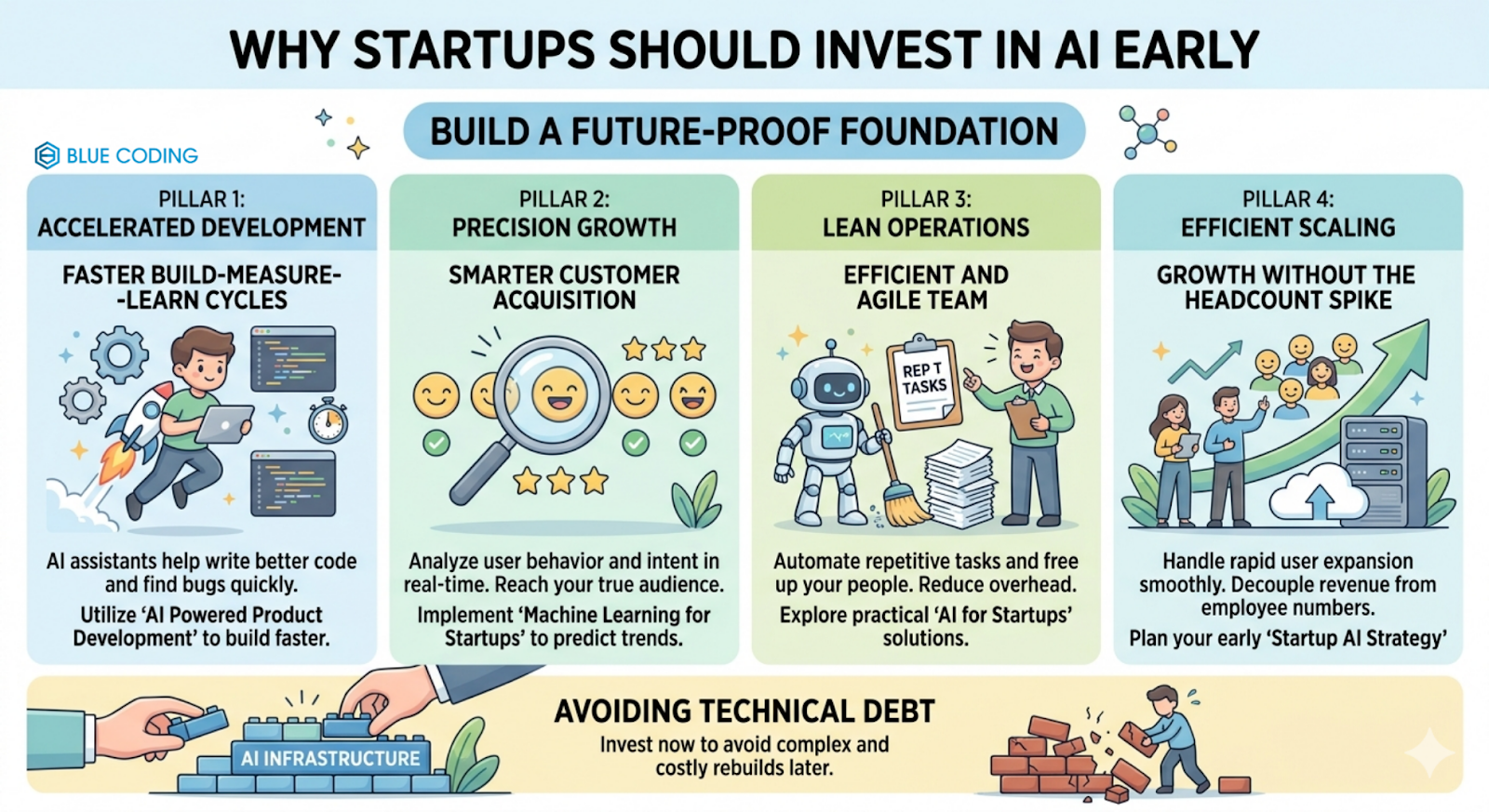
Scaling a business traditionally meant a massive spike in overhead. You needed more people to handle more customers. With a robust startup AI strategy, the relationship between revenue and headcount is decoupled. This is the holy grail of startup growth. AI driven systems can handle 1,000 customers as easily as they handle 10. Whether it is automated supply chain management or predictive analytics that forecast market shifts, these tools provide a steady hand as you grow. You are not just building a product. You are building a scalable system that learns as it expands. This systemic intelligence becomes an asset that grows in value every day the company is in operation.
Choosing not to use AI today is the new form of technical debt. If you build your processes around manual workflows now, the cost of ripping and replacing those systems later will be enormous. It is much easier to bake intelligence into the foundation than it is to try and bolt it on to a legacy system later.
Incorporating machine learning for startups into your core architecture from the start ensures that your product is ready for the future. Whether it is using feature stores for data consistency or MLOps for model deployment, being AI native is a badge of credibility that investors look for. They are not looking for companies that plan to use AI. They want companies where AI is the baseline for innovation and the primary driver of efficiency.
The competitive advantage in the modern economy goes to the fast. AI powered product development is not just about code. It is about market intelligence. AI tools can now track emerging trends and competitor moves as they happen, giving founders the data they need to pivot before a crisis hits.
When you combine this with the efficiency of AI for startups, you get a company that moves at the speed of the market, not at the speed of a manual approval process. This speed allows you to capture market share before larger competitors even realize there is a shift in consumer behavior.
Venture capitalists are increasingly looking for more than just a good idea. They are looking for operational excellence. A startup that utilizes AI for startups to keep its burn rate low while maintaining high output is a much more attractive investment than one that relies on heavy hiring to meet every new challenge.
Investors see an early startup AI strategy as a sign of forward thinking leadership. It demonstrates that the founders understand the technological landscape and are prepared to defend their market position against future disruption. By showing that you have integrated machine learning for startups into your roadmap, you prove that your business model is built for long term sustainability rather than short term hype.
At the end of the day, your startup exists to solve a problem for a customer. AI allows you to solve those problems more effectively. Automated support systems can provide instant answers at 3 AM. Recommendation engines can help users find exactly what they need without searching through pages of options. When you use AI powered product development to create these features, you are showing your customers that you value their time. This builds trust and loyalty, which are the two most valuable currencies for a new company. A startup that feels like it knows its customers personally will always outperform a generic competitor.
The transition from experimental AI to enterprise wide integration is nearing completion. For startups, the early adoption phase provides a unique window to out-innovate larger and slower competitors. By the time 2030 arrives, the companies leading the market will be those that viewed AI as a strategic partner from their very first hire. Those who wait will find themselves playing a permanent game of catch up, trying to train models on data they failed to collect and trying to automate processes that have already become obsolete. The time to invest is now, while the playing field is still being defined and the opportunities for disruption are at their peak.
Blue Coding - Your Key to Success in the AI Era
Blue Coding works on helping companies navigate the complexities of modern software development and SEO strategy. We understand that the shift toward an AI driven economy can feel overwhelming, which is why we focus on practical and high impact solutions that deliver measurable ROI. If you are looking to integrate advanced systems or boost your brand visibility in the new generative search landscape, we are here to help. We provide a first free call for queries to discuss your specific needs and help you map out a path for growth. You can contact us here to book your call!


Subscribe to our blog and get the latest articles, insights, and industry updates delivered straight to your inbox