Hiring developers is expensive, but losing them is even worse. Learn why free snacks won’t save your retention rates and how to build a remote culture that keeps your best software engineers from answering that next LinkedIn recruiter.


.svg)
.svg)
Building a high-performing team of developers is one of the most expensive and time-consuming tasks a tech leader faces. However, the true challenge is not the hiring process itself. The real struggle is keeping those engineers once they are on board. In a global market where a new job offer is only one LinkedIn message away, building genuine software engineer loyalty has become a survival skill for growing companies.
The traditional office perks like free snacks and ping-pong tables are irrelevant in a remote world. Today, distributed engineers care about different things. They want autonomy, a voice in the product roadmap, and a developer experience that allows them to do their best work without unnecessary friction. To keep your best talent, you have to move beyond transactional relationships and focus on building a community where people feel valued for their brains, not just their keyboard output.
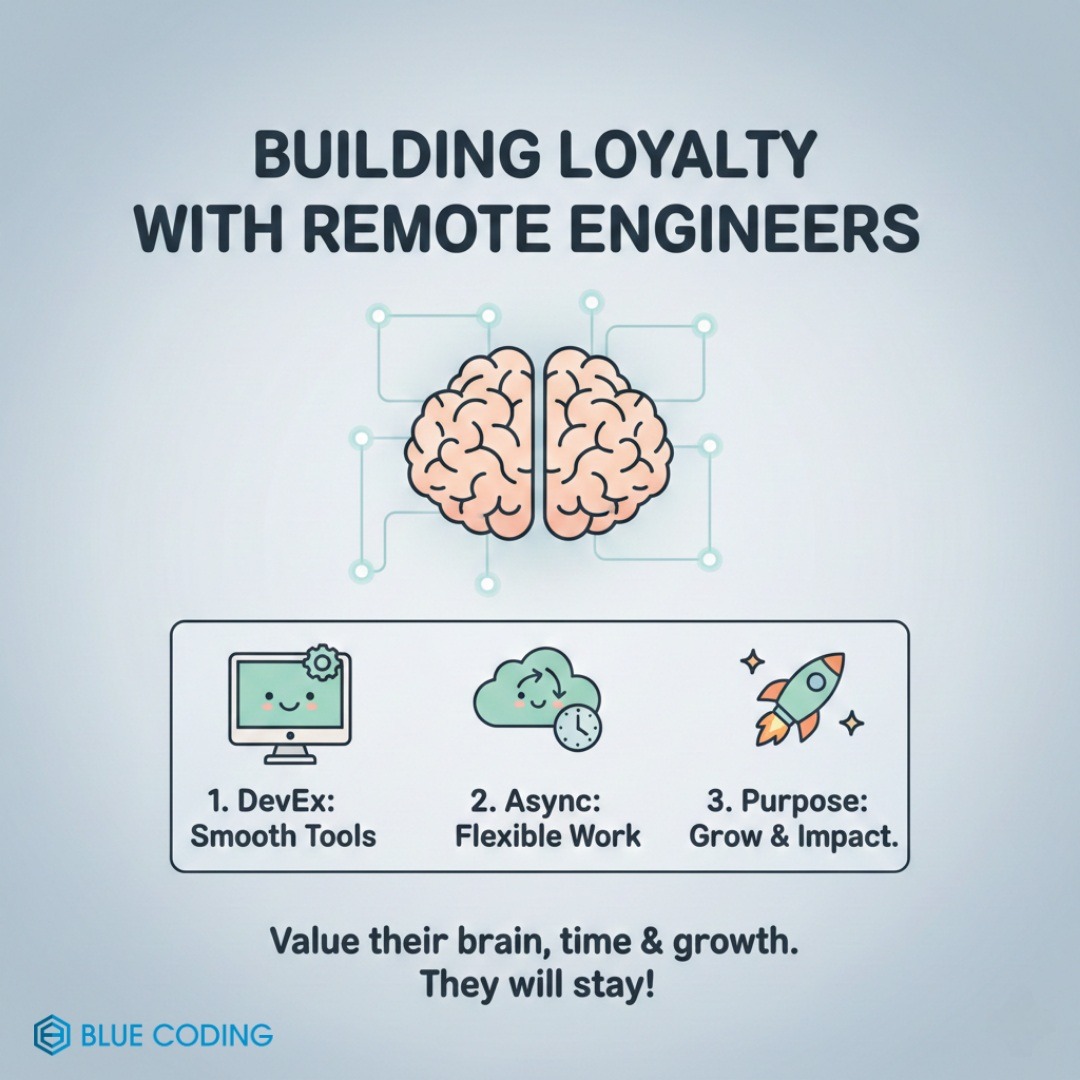
If you want to improve remote developer retention, you have to look at the daily life of your engineers. Developer Experience, or DevEx, refers to how easy or difficult it is for a coder to get their work done. When engineers are forced to deal with broken builds, slow deployment processes, or outdated documentation, they become frustrated. Frustration is the leading cause of turnover. High-quality engineers want to build things. When they spend half their day fighting with tools instead of writing code, they start looking for a company that has its technical act together. A smooth DevEx is the ultimate sign of respect for an engineer's time.
Building a healthy distributed team culture requires a shift in how you view time. The standard nine-to-five office day is largely dead. When your team is spread across different continents, trying to force everyone into the same meeting windows leads to burnout and exhaustion.
Instead of relying on real-time meetings, move toward asynchronous communication. This means using tools like Slack, Notion, or Loom to share updates that people can consume when it fits their schedule. This level of flexibility shows that you trust your engineers to manage their time, which is a massive driver of loyalty.
In an async-first culture, work happens in the open. Decisions are documented in public threads rather than closed calls. This ensures that a developer in a different time zone doesn't wake up to a project that has completely changed direction while they were asleep. When people feel informed, they feel included. When they feel included, they stay.
One reason software engineer loyalty is so low in many companies is that developers feel like ticket-taking machines. They receive a task in Jira, they code it, and they move to the next one without ever seeing the impact of their work. This leads to a mercenary mindset where the engineer is only there for the paycheck.
To keep an engineer engaged, you must connect their daily tasks to the bigger picture. They need to know why a specific feature matters to the user and how it helps the business grow. When an engineer feels like a partner in the product's success, they are much less likely to leave for a slightly higher salary elsewhere.
Key Insight: Don't just give your developers the "what." Give them the "why." Invite them to sit in on user interviews or share customer success stories during all-hands meetings. Seeing a customer's life made easier by code they wrote is a more powerful motivator than any corporate mission statement.
Engineering is a creative process that requires intense focus. It can take 20 to 30 minutes for a developer to get into a "flow state" where they are at their most productive. Every time a "quick" meeting or an urgent Slack message interrupts them, that timer resets. Poor remote team engagement often stems from a lack of respect for this focus. If your culture demands instant replies to messages, you are effectively telling your engineers that their focus is not a priority. Over time, this constant context-switching leads to mental fatigue and a feeling of unproductivity.
5. Creating Transparent Career Pathways
A major factor in remote developer retention is the "nowhere to go" feeling. In a physical office, career progression is often visible. In a distributed team, an engineer might feel like they are working in a vacuum. If they don't see a clear path to becoming a Senior, Lead, or Principal engineer, they will eventually find a company that offers that path. Don't wait for an annual review to talk about career goals. Have regular one-on-one meetings that focus on professional development, not just project updates.
In a distributed team culture, it is easy for small misunderstandings to turn into major conflicts. Because you cannot see body language over text, a short comment can be interpreted as rude or aggressive. This can lead to a toxic environment where engineers are afraid to speak up. Building loyalty requires a high level of psychological safety. Engineers need to know that they can admit to a mistake, ask a "stupid" question, or challenge a technical decision without being punished. When people feel safe, they take more risks and innovate more. Cultivate this by having leaders admit their own mistakes publicly. When a server goes down, focus on a "blameless post-mortem" that looks at the process failure rather than pointing fingers at an individual. This builds a bond of trust that is very hard for a recruiter to break.
While culture and tools are vital, we cannot ignore the financial aspect. To maintain remote team engagement, you must offer competitive compensation. This doesn't necessarily mean being the highest payer in the world, but it does mean being fair and transparent.
In a remote world, salary data is public. If your engineers find out they are being paid significantly less than market rate for their region and skill level, they will feel undervalued.
Building a loyal team is not about one big gesture. It is about the hundreds of small decisions you make every day. It is about choosing documentation over meetings, trust over micromanagement, and growth over stagnation. The Blue Coding team has spent years refining the art of distributed engineering. We have seen that the most successful companies are not those with the biggest budgets, but those that treat their developers as human beings with lives, ambitions, and a need for focus. When you create an environment where engineers feel respected and empowered, they don't just stay. They do the best work of their lives! If you're interested in hiring developers for your firm or project, consider Blue Coding! Contact us today and book a free strategy call to learn more about how we can help you.


Subscribe to our blog and get the latest articles, insights, and industry updates delivered straight to your inbox