Is your development partner AI-ready? Learn how to assess AI literacy, security awareness, and enterprise AI integration capabilities.


.svg)
.svg)
engineering teams were experimenting. Today, companies that have not figured out how to integrate AI into their development workflow are already falling behind, and the gap is widening every quarter. But here is the part most CTOs are not talking about openly. The real risk is not whether your internal team is AI-ready. It is whether your outsourced team is.
If you are relying on a nearshore or offshore development partner to build or maintain a significant part of your product, their AI literacy directly affects your output quality, your delivery speed, and your ability to compete. And most vendor evaluation processes were not designed to surface this. According to McKinsey's 2025 State of AI report, companies that have successfully integrated AI into their software development workflows report productivity gains of up to 40 percent compared to teams that have not. That number should be on every CTO's radar when they are evaluating who they trust to build their product. This post gives you five direct questions to put to your outsourced team, and explains why each one matters for your CTO software strategy going into 2026.
Most vendor assessment frameworks were designed to evaluate things like technical skill in specific languages, communication quality, time zone compatibility, and delivery track record. All of that still matters. But none of it tells you whether the team sitting on the other side of your Slack channel is equipped to work in a world where AI tools are reshaping how software gets written, reviewed, tested, and shipped. A developer who is not using AI-assisted coding tools in 2025 is not just missing a productivity boost. They are working with a fundamentally different set of inputs than the teams they are competing with. And that gap has consequences for the companies depending on them.
When we talk about AI readiness assessment for vendors, we are not asking whether developers have played around with a chatbot. We are asking whether they understand how to use AI tooling responsibly and effectively within a professional engineering context.
That means things like knowing when to trust an AI-generated code suggestion and when to push back on it. It means understanding the security implications of feeding proprietary code into third-party AI tools. It means being able to identify AI-generated code that looks correct but introduces subtle bugs or architectural problems. These are skills that separate AI-capable developers from developers who are simply adjacent to AI tools. Before you can do a meaningful AI readiness assessment for vendors, you need to know which category your outsourced team falls into.
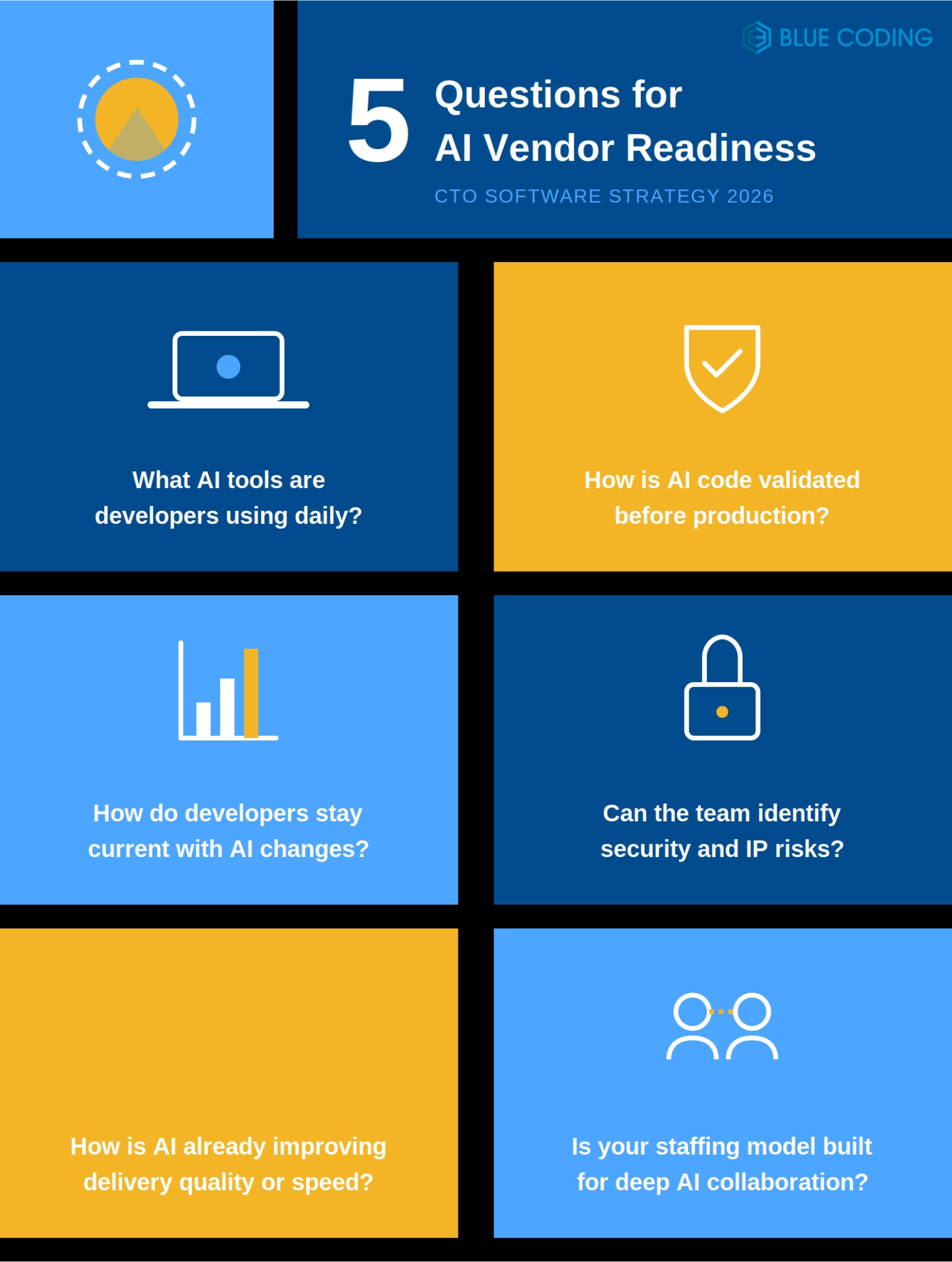
This is the starting point. A team that has not integrated any AI tooling into their day-to-day process is behind. Full stop. You want specifics here, not vague references to being open to AI.
Are they using GitHub Copilot, Cursor, or similar AI coding assistants? Are they using AI for code review, test generation, or documentation? How are those tools being managed at the team level in terms of security and code quality standards? If the answer is that individual developers use some AI tools occasionally but there is no team-level approach or policy around it, that tells you something important about where their AI maturity actually sits.
This is the question that separates teams that use AI thoughtfully from teams that use it recklessly. AI coding tools produce confident-looking output that is sometimes subtly wrong. A strong team has a clear process for reviewing, testing, and validating AI-generated code before it goes anywhere near your production environment. If your outsourced team cannot answer this question with specifics, that is a meaningful gap in your enterprise AI integration strategy. The risk is not that they are using AI tools. The risk is that they are using them without the judgment layer that makes those tools safe to rely on.
The AI tooling landscape in software development is moving fast. What was the leading approach six months ago may already have a better alternative. A team that is genuinely invested in AI readiness has developers who are actively learning, not just waiting for their employer to tell them what tool to use next. Ask specifically how the team approaches professional development around AI. Do they have internal knowledge-sharing processes? Are engineers expected to stay current with developments in their area? This matters because evaluating AI literacy in developers is not just about current capability. It is about trajectory. A team with a strong learning culture will close any current gaps. A team without one will fall further behind regardless of what tools they have access to today.
This is the question most CTOs forget to ask, and it is one of the most important ones for enterprise AI integration. When developers use AI coding assistants, they are often sending code snippets, architectural context, and business logic to third-party servers. Depending on the tool and its configuration, that information may be stored, used for training, or otherwise retained outside your organization's control.
A team with genuine AI maturity understands this risk and has policies in place to manage it. They know which tools are approved for use with client code and which are not. They understand the difference between using a locally hosted AI model and a cloud-based one in terms of data exposure. They have thought about this, not just technically but from a commercial and contractual standpoint. If your outsourced team gives you a blank look when you raise this question, the gap is significant. Not because the tools are necessarily unsafe, but because using them without awareness of the risk is.
This is the most direct question of the five and the most revealing. If a team is genuinely AI-capable, they should be able to point to specific ways they are already using AI to benefit your project. Faster test generation. Improved code documentation. More thorough code review. Catching edge cases earlier.
If the honest answer is that AI is something they are planning to explore at some point in the future, that is useful information. It tells you that your current outsourced setup may not be positioned to give you the competitive advantage that enterprise AI integration can deliver.
The goal of these five questions is not to catch your outsourced team out. It is to get an honest picture of where they sit on the AI maturity curve, and what that means for your CTO software strategy going into 2026.
Some teams will have strong, specific answers to all five. Those are the partners worth doubling down on. Some will have partial answers that reveal genuine investment in AI capability but acknowledged gaps. Those are conversations worth having openly. And some will reveal that AI is simply not something the team has engaged with in any meaningful way, which is important to know before it starts costing you.
AI readiness does not exist in a vacuum. It needs to be evaluated alongside how your outsourced team is structured and how embedded they are in your actual product development process. A team that operates at arm's length through a traditional outsourcing arrangement is structurally less likely to develop the AI fluency that comes from working closely with your internal engineers and your codebase.
This is one of the reasons tech staff augmentation and nearshore software development continue to outperform traditional outsourcing for companies that take product quality seriously. When developers are embedded in your team, using your tools, working in your workflows, they develop the context and capability that makes responsible AI usage possible. This breakdown of how staff augmentation compares to managed teams is a useful starting point. And if you are still evaluating whether to scale your engineering team at all before addressing this, this post on scaling your engineering team quickly in Q4 covers the operational decisions that sit upstream of the AI readiness question.
The tricky thing about AI readiness gaps in outsourced teams is that they do not always show up immediately in delivery metrics. A team can still hit sprint goals and pass code review while quietly falling behind on the practices and tooling that will determine quality and speed six months from now.
The time to ask these questions is not when you notice a problem. It is now, while you still have the room to make adjustments without disrupting delivery. If you have not had this conversation with your outsourced team, the fact that you are reading this post is a good enough reason to schedule it this week.
The companies that get enterprise AI integration right are not the ones with the biggest AI budgets. They are the ones with the clearest view of where their teams actually stand, and the willingness to act on that information.
Blue Coding is a nearshore software development and tech staff augmentation company that connects US businesses with senior, English-proficient engineers across Latin America who are technically vetted, AI-capable, and ready to integrate into your team from day one.
If you are re-evaluating your outsourced engineering setup in light of where AI is taking the industry, we are happy to be part of that conversation. Our post on the hidden cost of cheap code covers why the cheapest option in outsourcing rarely stays cheap for long, and what to look for in a partner that is built to grow with you.
We offer a free first call with no commitment and no pressure. Just a direct conversation about where your team is, where you want it to be, and whether we are the right fit to help you get there. Book your free call with Blue Coding now!


Subscribe to our blog and get the latest articles, insights, and industry updates delivered straight to your inbox