Is your stack ready for peak traffic? Discover the essential pre-holiday software infrastructure audit steps to prevent downtime. This guide covers software performance optimization for scaling businesses to keep your systems running smoothly.


.svg)
.svg)
The fourth quarter is the ultimate stress test for any scaling organization. Whether you are a retail giant prepping for Black Friday or a B2B SaaS company bracing for the end-of-year renewal rush, Q4 is the period where systems break, servers sweat, and technical debt finally sends its bill. We have seen companies double their revenue in December and others lose it all because their checkout page had a minor database lock issue. The difference is always a proactive approach to the software stack.
If you want to avoid the 2 AM emergency Slack calls, you need more than just hope. You need a comprehensive technical audit for growing companies. This guide will walk you through a deep, software readiness checklist to ensure your infrastructure isn't just surviving, but thriving.
Scaling is not just about having more of everything. It is about how your systems handle sudden, jagged spikes in traffic. If your user base jumps five times in an hour, does your cloud provider scale up seamlessly, or does it just rack up a massive bill while your site stays down?
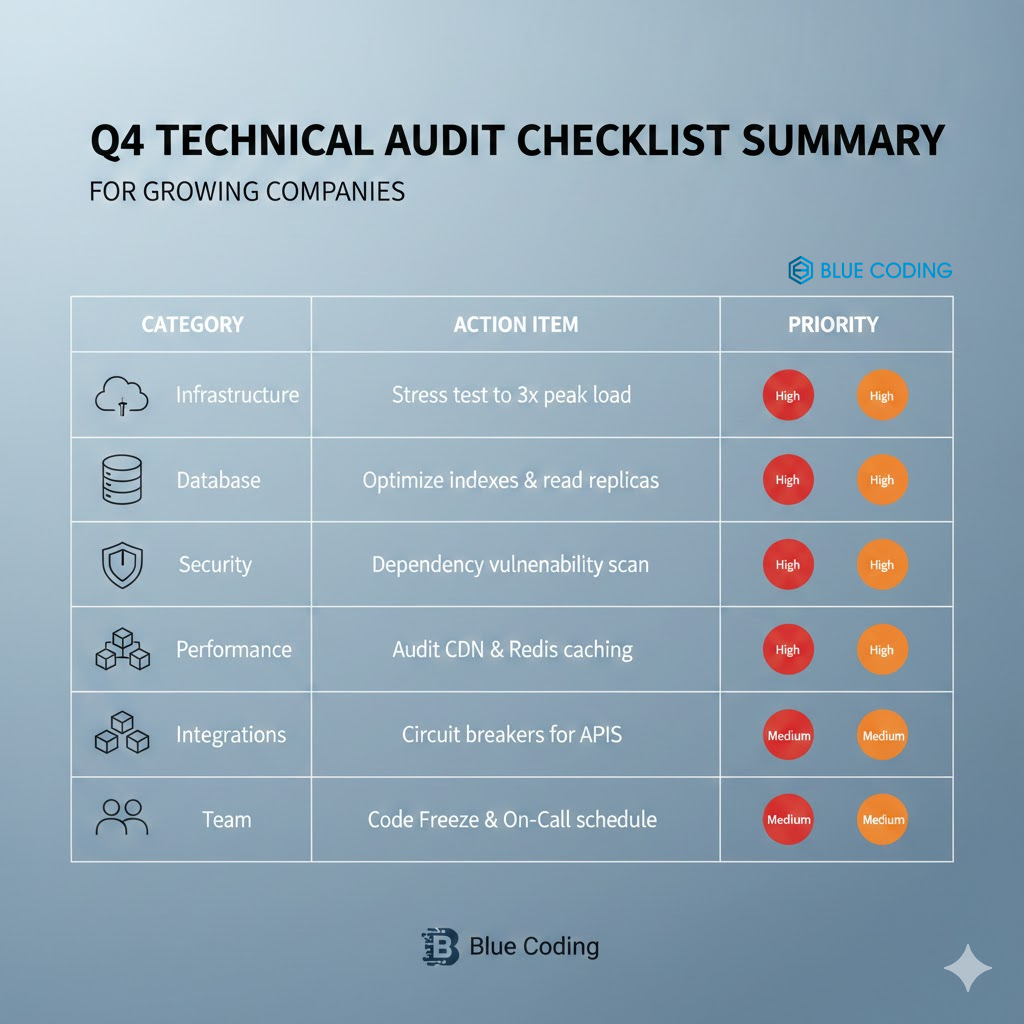
Most companies claim they have auto-scaling, but few have actually tested it under pressure. Your pre-holiday software infrastructure audit must include the following:
Scaling is expensive. Part of your audit should be looking at your reserved instances and spot instances. There is no point in paying on-demand prices for a predictable Q4 surge if you can lock in lower rates now. Many companies find that their cloud bill triples in Q4 because they didn't set proper budget alerts or auto-scaling limits.
A slow site is a broken site. In Q4, latency is the silent conversion killer. If your database is taking 500ms to return a query, by the time it hits the front end, your user has already closed the tab and moved to a competitor.
Your database is usually the first thing to buckle. As part of your software performance optimization for scaling businesses, check the following:
If you are not caching, you are not scaling. We recommend a three-tier approach to ensure your Q4 software readiness checklist is complete:
Q4 is also the most popular time for bad actors. While you are busy selling, hackers are busy looking for open windows. A pre-holiday software infrastructure audit is not complete without a security sweep that goes beyond the surface level.
High traffic attracts bots. Whether it is scalper bots trying to buy up inventory or credential stuffing attacks, you need a defense layer.
One of the biggest risks in modern software is the Shadow Dependency. You might trust your code, but do you trust the random NPM package your dev team installed three years ago?
Growing companies often move fast and break things. That is fine in Q1, but by Q4, those temporary fixes are now permanent liabilities.
Identify the messy parts of your codebase that sit right in the middle of your critical path. If your checkout logic is a 2,000-line function that no one understands, it is time to break it down. Clean code is not just about aesthetics. It is about software performance optimization for scaling businesses. Clean code is easier to debug when things go sideways at 4 PM on a Friday.
The 80/20 Rule of Audits: 80% of your bugs will come from 20% of your code. Identify those 20% danger zones and give them extra love during your audit. If you have legacy modules that haven't been touched in years, Q4 is when they will likely fail under high load.
In 2026, the majority of Q4 traffic comes from mobile devices. If your mobile experience is an afterthought, your technical audit is incomplete.
You are only as strong as your weakest integration. If your payment gateway or shipping API goes down, your site is effectively down too.
Your software might be ready, but is your team? The best Q4 software readiness checklist includes the people who maintain the machines.
Who is the Point of Truth if the API goes down on a holiday?
Most successful companies implement a code freeze starting mid-November. This means no new features, only critical bug fixes. This prevents the just one more small feature trap that inevitably introduces a regression right before the biggest sales day of the year. A pre-holiday software infrastructure audit should conclude with a hard date for this freeze.
An audit is a snapshot in time, but Q4 is a marathon. You need real-time eyes on your system.
Why a Technical Audit for Growing Companies is Non-Negotiable
Growth is a double-edged sword. More users mean more revenue, but they also mean more pressure on every line of code you have ever written. By performing a technical audit for growing companies early in the year, you give your team the time to fix the foundation before the house gets crowded.
Q4 should be about celebrating your growth, not fighting fires. If your current team is buried under feature requests and does not have the bandwidth to run a deep-dive audit, it might be time for some outside help. A pre-holiday software infrastructure audit is the best insurance policy your business can buy.
The difference between a record-breaking quarter and a site-wide crash often comes down to the hands on the keyboard. Blue Coding has embedded itself into your mission to ensure your architecture is as ambitious as your business goals. Whether you are battling legacy code or scaling to meet global demand, our specialized engineering teams provide the high-level technical audit for growing companies that turns infrastructure from a bottleneck into a competitive advantage. We specialize in software performance optimization for scaling businesses, helping you navigate the complexities of Q4 without the typical fire drills. If you are tired of patching holes and ready to build a resilient, high-performing foundation, we are ready to step in. Contact us today and let's get to work. We offer a complimentary strategy call to dive deep into your unique challenges and map out a path to a stress-free Q4.


Subscribe to our blog and get the latest articles, insights, and industry updates delivered straight to your inbox