Is your Q4 technology readiness strategy airtight? Explore the essential steps for performance and security reviews that keep your business growing smoothly.


.svg)
.svg)
It is officially the primary days before the Q4 storm. For most people, this means autumn vibes and a slower and calmer pace of life. But if you are part of the leadership team at a high-growth company, this period is actually the most critical window you have. It is the only time left to fix your foundation before the pressure of the fourth quarter hits. In October or November, traffic spikes, and suddenly the minor bugs that were easy to ignore in May become existential threats to the business. The goal of this post is to give you a clear roadmap to avoid that fate. We are going to look at what the top-performing companies are doing right now to ensure their systems do not just survive Q4, but thrive during it.
Why is Q3 your magic window? It comes down to the lead time required for meaningful engineering changes. If you identify a major architectural bottleneck too late, your team is likely focused on feature freezes and marketing support. You cannot perform a massive database migration or a full security overhaul when you are a few weeks away from your biggest sales event of the year.
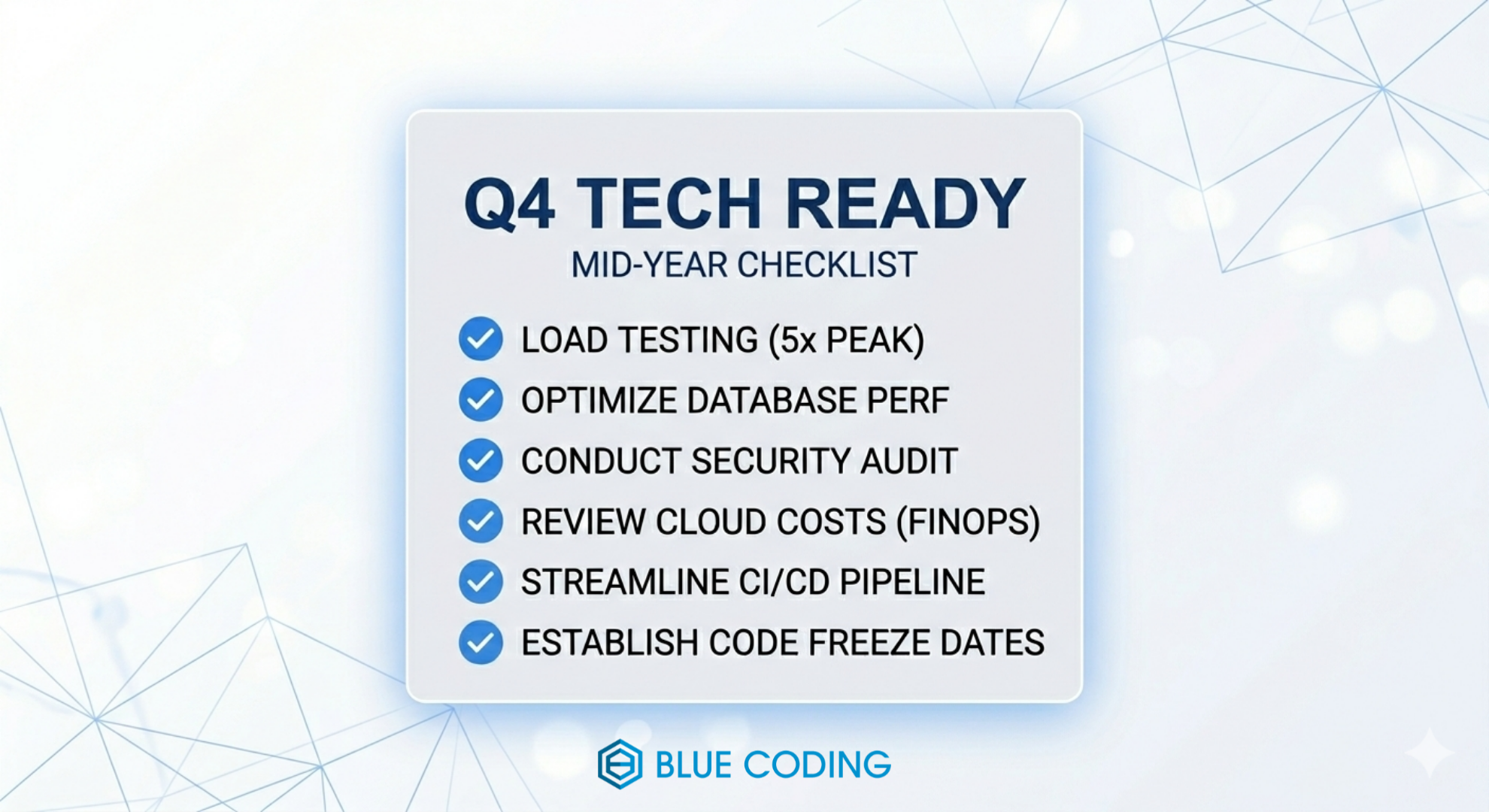
The smartest technical leaders use this time to run a comprehensive mid year tech audit checklist. This is about identifying the silent killers in your stack. These are the small performance lags, the messy permissions, or the unoptimized cloud costs that feel manageable now but will break under ten times the current load.
When we talk about scaling infrastructure for high growth companies, we are talking about more than just adding more servers. In the modern cloud era, scaling is an exercise in efficiency and elasticity.
Your database is almost always the first thing to fail. During a mid-year review, you should be looking at your most frequent queries. Are they still indexed correctly? As your data grows, an index that worked perfectly six months ago might now be causing slow-table scans. You should also evaluate your read-write splits. If you are still hitting a single primary instance for every single request, Q4 is going to be painful. Setting up read replicas now gives your team time to test the implementation before the traffic arrives.
High growth often leads to what we call cloud sprawl. This happens when teams spin up new environments for testing and forget to turn them off, or when you are paying for high-availability features on services that do not actually need them. A thorough mid year tech audit checklist should include a line item for FinOps. Look at your AWS or Azure bill. If your costs are growing faster than your user base, your infrastructure is not scaling; it is just leaking money.
Security is often treated as a separate department, but for high-growth companies, it is deeply tied to performance. A system that is under a Distributed Denial of Service attack or a simple surge in bot traffic will perform poorly for legitimate users.
Your team has likely been shipping features at a breakneck pace for the last six months. In that rush, it is easy to let library updates slide. Now is the time to conduct a formal software performance and security review. Check your dependency tree. Are you running versions of packages with known vulnerabilities? Tools like Snyk or GitHub Advanced Security can help, but they require a human to actually prioritize the fixes.
Performance is a feature. If your checkout page takes three seconds to load, you are losing money. Use this mid-year period to look at your P99 latency. How does the system behave for the slowest 1 percent of your users? Usually, these users are the ones on mobile devices or slower connections. If you can optimize the experience for them now, you will see a massive lift in conversion rates when your Q4 marketing campaigns kick in.
A Q4 technology readiness strategy is a formal document that outlines exactly how the company will handle the end-of-year surge. It should cover everything from code freeze dates to emergency communication protocols.
High-growth companies often struggle with the urge to keep shipping until the very last minute. This is a mistake. You need to establish a clear code freeze window. This does not mean engineering stops working; it means you stop pushing high-risk changes to production. Use the weeks leading up to the freeze to focus on bug fixes, documentation, and internal tools.
Do not guess how much traffic you can handle. You should be running load tests that simulate at least three to five times your current peak traffic. The goal is to find the breaking point. Does the API gateway throttle first? Does the load balancer give up? Does the cache hit a memory limit? Finding these answers in July allows you to reconfigure your environment. Finding them in November usually results in an emergency all-hands meeting and a crashed website.
Technical debt is like financial debt; a little bit is fine to move fast, but the interest will eventually kill you. During the first half of the year, your engineers probably took some shortcuts to hit deadlines. That is a normal part of growth. However, if you do not pay down that debt now, it will compound.
As part of your software performance and security review, ask your senior developers where the "bodies are buried." They know which parts of the codebase are brittle. They know which legacy microservice is held together by hope and duct tape. Give them the permission and the time to refactor those critical paths. This is an investment in the stability of your entire platform.
We often focus on the code, but scaling infrastructure for high growth companies also involves scaling the people. If your deployment process requires a specific lead engineer to be present, you have a single point of failure.
If you plan on hiring more developers to help with the Q4 push, your onboarding needs to be seamless. Check your README files and internal wikis. If a new hire cannot get a local development environment running within a few hours, your documentation is broken. Improving this now ensures that any new talent you bring on can actually contribute instead of just taking up the time of your senior staff.
What happens when things go wrong? Even with the best preparation, bugs happen. Your Q4 technology readiness strategy must include an updated on-call rotation and an incident response playbook. Everyone on the team should know who to contact and what the escalation steps are. If you wait until a server goes down to figure out who has the login for the logging provider, you have already lost.
The work you do now determines the story you will tell in January. You can either tell a story about how your company handled record-breaking traffic with ease, or you can tell a story about the "one that got away" because the site was down during a flash sale. A successful end to the year is not an accident. It is the result of a disciplined approach to your tech stack during the months when the pressure feels lower. By running through your mid year tech audit checklist and committing to a solid Q4 technology readiness strategy, you are giving your company the best possible chance to succeed.
We are a team of developers, code architects, and tech enthusiasts who believe that great software is the backbone of every successful modern business. At Blue Coding, we have spent years working from the inside of high growth companies to solve the exact problems mentioned in this guide. We do not just give advice from the sidelines; we get into the code and the infrastructure with you. Our focus is on staff augmentation and specialized project management, helping companies find the elite technical talent they need to scale without the headache of traditional hiring. We are here to make sure your technology is an accelerator for your growth, not a speed bump. If you are looking at your Q4 goals and feeling like your current team needs more support to get there, we should talk. You can contact us today to learn more about how we can help you implement your audit and scaling plans!


Subscribe to our blog and get the latest articles, insights, and industry updates delivered straight to your inbox