Get a reality check on your tech strategy! This post explores nearshoring case studies and shows how modern managed IT services have evolved to prioritize quality.


.svg)
.svg)
A few years ago, hiring a remote team was mostly about finding a lower hourly rate to keep the budget under control. Today, the game is entirely different. With AI-driven development and a hyper-competitive global market, the old ways of outsourcing are leading to more failures than successes. After navigating more than 100 different engagements, we have gathered a wealth of nearshore outsourcing lessons that separate the winners from those who end up with buggy code and missed deadlines. This is the reality check that every tech leader needs to hear before signing their next contract. Building a global team is no longer a luxury for the elite tech firms of Silicon Valley. It is a necessity for any business that wants to scale without losing its soul or its bank account. However, doing it wrong is easier than doing it right.
A common mistake is hiring based purely on a resume or a list of coding languages. You might find the best Java developer in the world, but if they do not understand how your specific team works, the partnership is going to struggle. In our history of managing software outsourcing partnerships, we have found that technical skill is just the starting point. The real magic happens when the remote team shares your sense of urgency and your approach to problem-solving.
Culture is often dismissed as a soft skill, but in a high-stakes development environment, it is the hardest skill to master. When we talk about culture in a nearshoring context, we are talking about communication styles, feedback loops, and the willingness to take ownership of a product. If your internal team moves fast and breaks things, but your nearshore partner is waiting for a three-page documentation update before they write a single line of code, you have a fundamental mismatch.
When the culture of the nearshore team does not match your own, you face several invisible risks:
Real success in software outsourcing partnerships comes when the external team feels like they are sitting in the same room as you. They should be active in your messaging channels, participating in your brainstorming sessions, and feeling empowered to push back when they see a better way to build a feature. We have seen projects fail not because of a lack of talent, but because the two teams were speaking different professional languages. One team expected autonomy, while the other expected strict instruction. Bridging that gap is the first step toward a successful long-term relationship.
Back in the day, the primary goal of outsourcing was to save as much money as possible. In 2026, that mindset is dangerous. The most successful nearshoring case studies show that the top companies are no longer looking for the cheapest option. Instead, they are looking for what we call Capability-Based Savings.
This means you look at the Total Cost of Ownership rather than just the hourly rate. A senior developer who uses advanced AI tools to ship a clean feature in three days is far more valuable than a cheap junior developer who takes two weeks and creates technical debt that your team will have to pay for later. The market for talent has shifted. High-quality developers in Latin America or Eastern Europe know their worth. If you are chasing the lowest possible price, you are likely hiring the talent that everyone else passed on.
Quality is not an act, it is a habit. When you apply this to nearshoring, you realize that paying a premium for a proven partner actually saves you money over a twelve-month period. If you treat your nearshore team as a simple commodity, you will get a basic result. If you treat them as a high-performance engine, they will help you move faster than your competitors. We have analyzed dozens of nearshoring case studies where the deciding factor in success was the depth of the partner's expertise in specific niches like fintech or healthcare compliance. These are not areas where you want to cut corners. You want a team that knows the regulations and the security protocols better than you do.
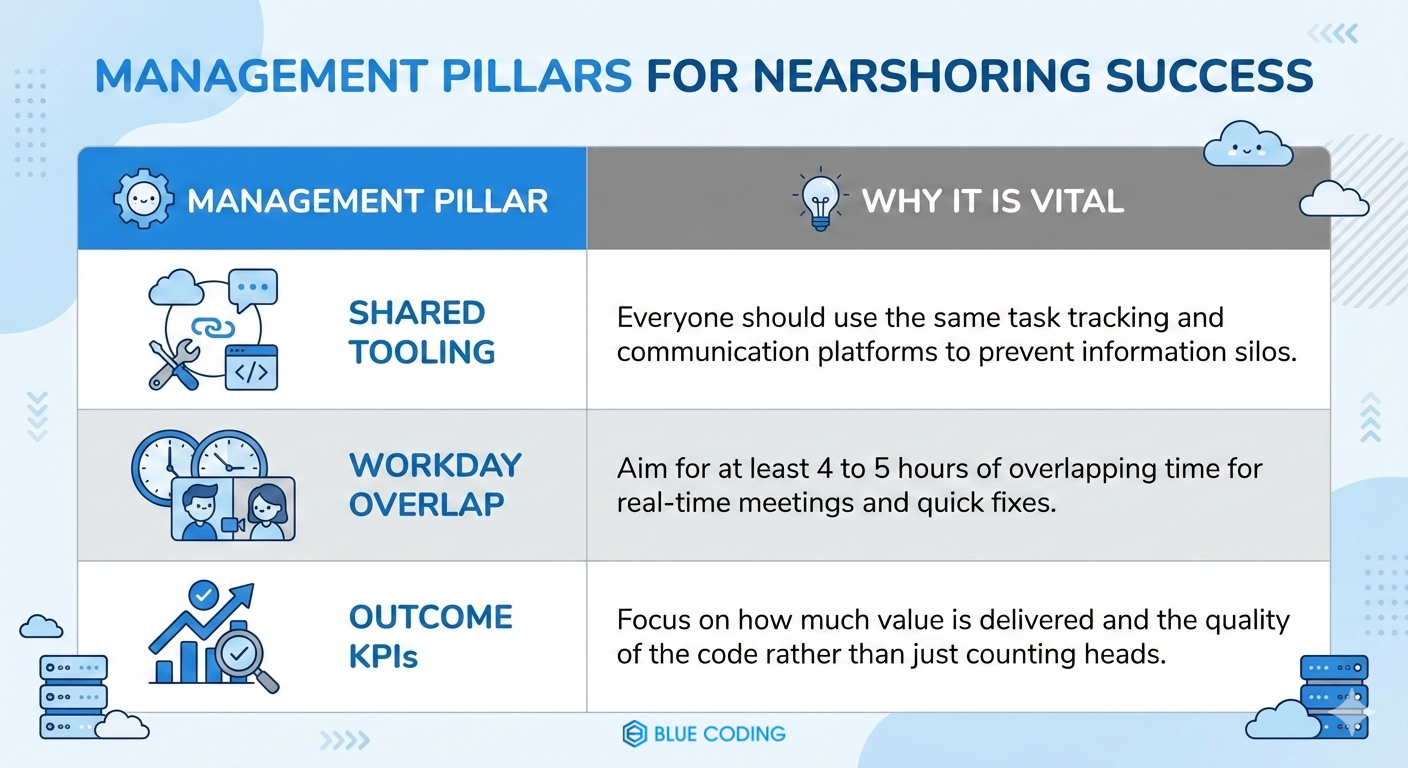
One of the most important nearshore outsourcing lessons we have learned is that you cannot just hire people and hope for the best. You need a framework to manage the work. Partnerships fail most often during the handoff phase, where requirements get lost in translation. Governance is the structure that keeps everyone on the same page. It includes the tools you use, the frequency of your meetings, and the way you measure success. To fix this, successful companies use a model of high visibility. You need to know exactly what is happening in every sprint without having to micromanage every hour of the day. Without a clear governance structure, you end up with a black box where tasks go in and code comes out, but nobody knows if that code is actually solving the business problem.
In many nearshoring case studies, the turning point for a failing project was the introduction of better governance. Instead of sending a list of tasks once a week, the clients started including the nearshore team in daily stand-up meetings. This simple change reduced the time spent waiting for answers and allowed the developers to stay aligned with the changing needs of the business.
Modern managed IT services thrive on this kind of integration. When the workflow is seamless, the geographical distance becomes irrelevant. You should be looking for a partner who brings their own governance model to the table. They should be telling you how they report progress and how they handle roadblocks. If you have to invent the management process for them, you are taking on too much work. A mature partner comes with a playbook that has been refined over years of experience.
As we look toward the future, the lessons we have learned from over 100 partnerships suggest that the industry is moving toward a hybrid model. This involves a mix of internal leadership and external execution. The old way of throwing a project over the wall and waiting for a finished product is dead. The new way is continuous collaboration.
This requires a shift in how we think about remote work. It is no longer about distance; it is about connectivity. With the tools available in 2026, a developer in Medellin is effectively in the same room as a product manager in New York. The technology has solved the distance problem, but only human strategy can solve the partnership problem. This is one of the most vital nearshore outsourcing lessons we can share: invest in the relationship as much as you invest in the code.
Strategic Integration Tips:
Blue Coding takes the experience from these 100+ partnerships and uses it to help you build the engineering team you have always wanted. We know that the right software outsourcing partnerships are built on more than just code. They are built on trust and shared goals. We specialize in connecting you with elite talent that fits your culture and understands your vision. Our goal is to make sure your next step in nearshore outsourcing lessons leads to measurable results and long term success. We handle the heavy lifting of recruitment and management so you can focus on leading your industry. Contact us today to see how we can help you scale your operations effectively. We also provide a free strategy call to help you figure out the best path forward for your specific business needs.


Subscribe to our blog and get the latest articles, insights, and industry updates delivered straight to your inbox