Mexico is home to some of the most powerful tech stacks used in software development today. Discover the top 10 tech stacks in Mexico, used for AI, fintech, and more. Learn why developers and companies prefer these technologies for building modern software solutions.


.svg)
.svg)
What makes Mexico one of the most exciting tech hubs in the world? Is it the influx of highly skilled developers, the rapidly growing innovation ecosystem, or the perfect balance of quality and cost-effectiveness? Maybe it’s all of the above. From fintech breakthroughs to AI-powered solutions, Mexican software engineers are using the latest technologies to build powerful, industry-shaping applications. But which popular Mexican tech stacks are leading this revolution? In this article, we look into the top 10 tech stacks fueling Mexico’s software development scene while exploring what makes them stand out, where they shine the most, and why businesses are embracing them more than ever.
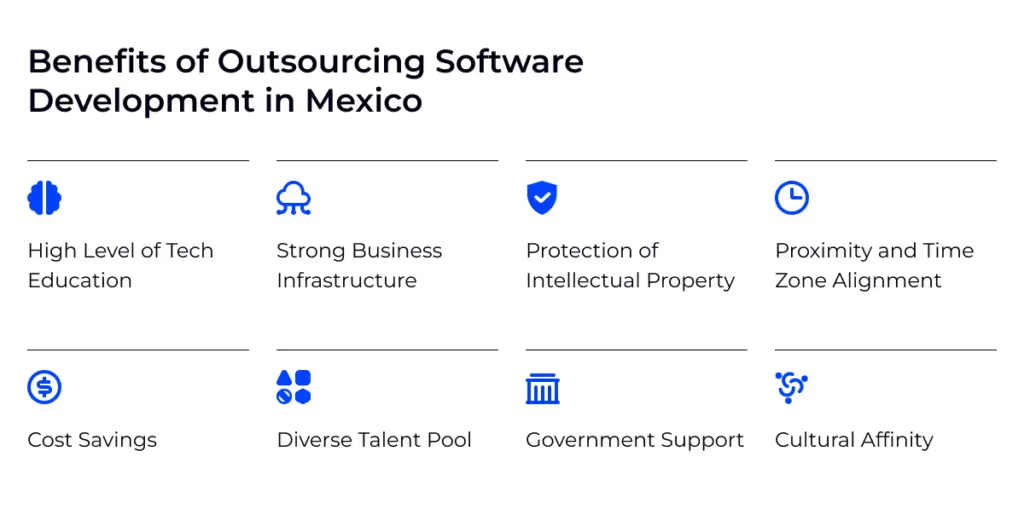
Over the past decade, Mexico’s tech industry has witnessed exponential growth, fueled by government support, foreign investments, and a thriving startup culture. Cities like Guadalajara, Monterrey, and Mexico City have evolved into major tech hubs, attracting global companies and fostering a new generation of highly skilled software engineers. One of the key reasons for this boom is Mexico’s strong educational system, which produces thousands of engineering graduates every year. Universities and coding boot camps continuously update their curricula to align with industry demands, ensuring that Mexican developers are proficient in the latest technologies.
Also, nearshore outsourcing has positioned Mexico as a prime destination for North American businesses looking to reduce costs without compromising quality. The country’s proximity to the U.S., shared time zones, and cultural alignment make collaboration seamless, allowing companies to scale their development efforts efficiently. With such a dynamic tech ecosystem, Mexican developers are working with a variety of powerful and popular Mexican tech stacks to build everything from scalable web applications to AI-driven solutions. Let’s take a closer look at the top 10 tech stacks shaping software development in Mexico today.
Elixir, a functional programming language built on the Erlang Virtual Machine (BEAM), has been gaining traction in Mexico, particularly for real-time applications that demand high concurrency and fault tolerance. Many startups and enterprise companies are turning to Elixir due to its lightweight processes, scalability, and reliability.
When combined with the Phoenix framework, Elixir becomes an excellent choice for:
Many companies in Mexico’s fintech and telecommunications sectors are adopting Elixir and Phoenix to build robust, low-latency systems that can handle thousands of simultaneous connections without performance degradation.
Rust is quickly becoming a favorite among developers in Mexico, particularly those working on systems programming, embedded devices, and high-performance applications. Known for its memory safety without garbage collection, Rust allows developers to build blazing-fast, secure, and efficient applications.
Mexican companies using Rust include:
As cybersecurity and IoT continue to grow in Mexico, Rust is becoming an essential tool for developers looking to build safe, high-performance applications.
Flutter, Google’s UI toolkit, is revolutionizing mobile app development in Mexico by enabling developers to build iOS and Android apps from a single codebase. This efficiency makes Flutter an attractive choice for startups and enterprises alike.
Mexican companies are using Flutter to develop:
With its hot reload feature, Flutter significantly reduces development time, making it easier for companies to bring new products to market faster.
Scala, a powerful hybrid programming language combining functional and object-oriented paradigms, is widely used in Mexico’s big data and AI industries. When paired with Akka, a toolkit for distributed and concurrent applications, Scala enables companies to handle large-scale data processing efficiently.
Common use cases in Mexico include:
With an increasing number of data-driven businesses in Mexico, Scala is becoming a go-to language for AI and big data applications.
Haskell is a purely functional programming language gaining traction in Mexico, particularly among fintech and cybersecurity firms. Its strong type system and mathematical precision make it an excellent choice for applications requiring high reliability and security.
Common use cases in Mexico include:
Haskell’s immutability and lazy evaluation provide developers with a robust framework for handling complex data structures without side effects.
Django, a high-level Python web framework, paired with PostgreSQL, is widely used in Mexico for enterprise applications, government portals, and fintech solutions.
This stack is favored for:
With Mexico’s growing emphasis on digital transformation, Django and PostgreSQL remain a reliable choice for scalable web applications.
Clojure, a Lisp-based functional language, is emerging as a key player in Mexico’s AI and automation sectors. Its immutable data structures and parallel computing capabilities make it well-suited for:
Clojure’s simplicity and efficiency make it an excellent tool for handling complex AI computations in real-time.
GraphQL, a query language for APIs, is becoming the preferred choice for building fast and flexible APIs in Mexico. When combined with Apollo Client, GraphQL enables efficient data fetching, real-time updates, and improved developer experience.
Industries benefiting from GraphQL include:
As businesses shift toward microservices and headless architectures, GraphQL is becoming a game-changer for modern web applications.
Kubernetes has become the backbone of cloud-native development in Mexico, allowing businesses to automate the deployment, scaling, and operations of containerized applications. When paired with Helm, developers can manage Kubernetes applications more efficiently, making it a go-to stack for enterprises and startups alike.
Why Mexican companies use Kubernetes and Helm:
As cloud adoption grows in Mexico, Kubernetes with Helm is becoming a key stack for companies looking to optimize their infrastructure.
Golang, known for its simplicity, speed, and concurrency capabilities, is widely used in Mexico for backend development, microservices, and networking applications. The Gin framework enhances Go’s performance by providing a lightweight, fast, and modular web framework.
Examples of uses for Go and Gin in Mexico:
With an increasing demand for performance-driven backend systems, Go and Gin are solidifying their place in Mexico’s software development ecosystem.
Looking for elite software engineers in Mexico? Blue Coding makes outsourcing to Mexico easier as it connects businesses with skilled developers who excel in technologies and programming languages. Whether you need cloud engineers, AI specialists, or mobile app developers, we can help you build the perfect nearshore team. Contact us today and book your free discovery call to discover how nearshore development in Mexico can accelerate your software initiatives.


Subscribe to our blog and get the latest articles, insights, and industry updates delivered straight to your inbox