Tired of vague quotes? Get the exact 2025 nearshore staff augmentation rates by seniority and learn the true cost comparison against full-time US hires.


.svg)
.svg)
Every engineering leader who has explored nearshore staffing has run into the same vague pricing language. Rates vary by experience level. Cost depends on location and specialization. Contact us for a quote. None of that helps you build an actual budget. This post breaks down what nearshore staff augmentation actually costs in 2025, what drives the variation in pricing, and how to think about the true cost comparison against hiring full-time in the US so you can build a budget that reflects reality rather than a marketing brochure.
According to Levels.fyi compensation data, senior software engineers at mid-size and large US tech companies now command total compensation packages averaging between 165,000 and 220,000 dollars annually when base salary, bonus, and equity are included. That figure is the baseline against which any nearshore cost comparison should be measured.
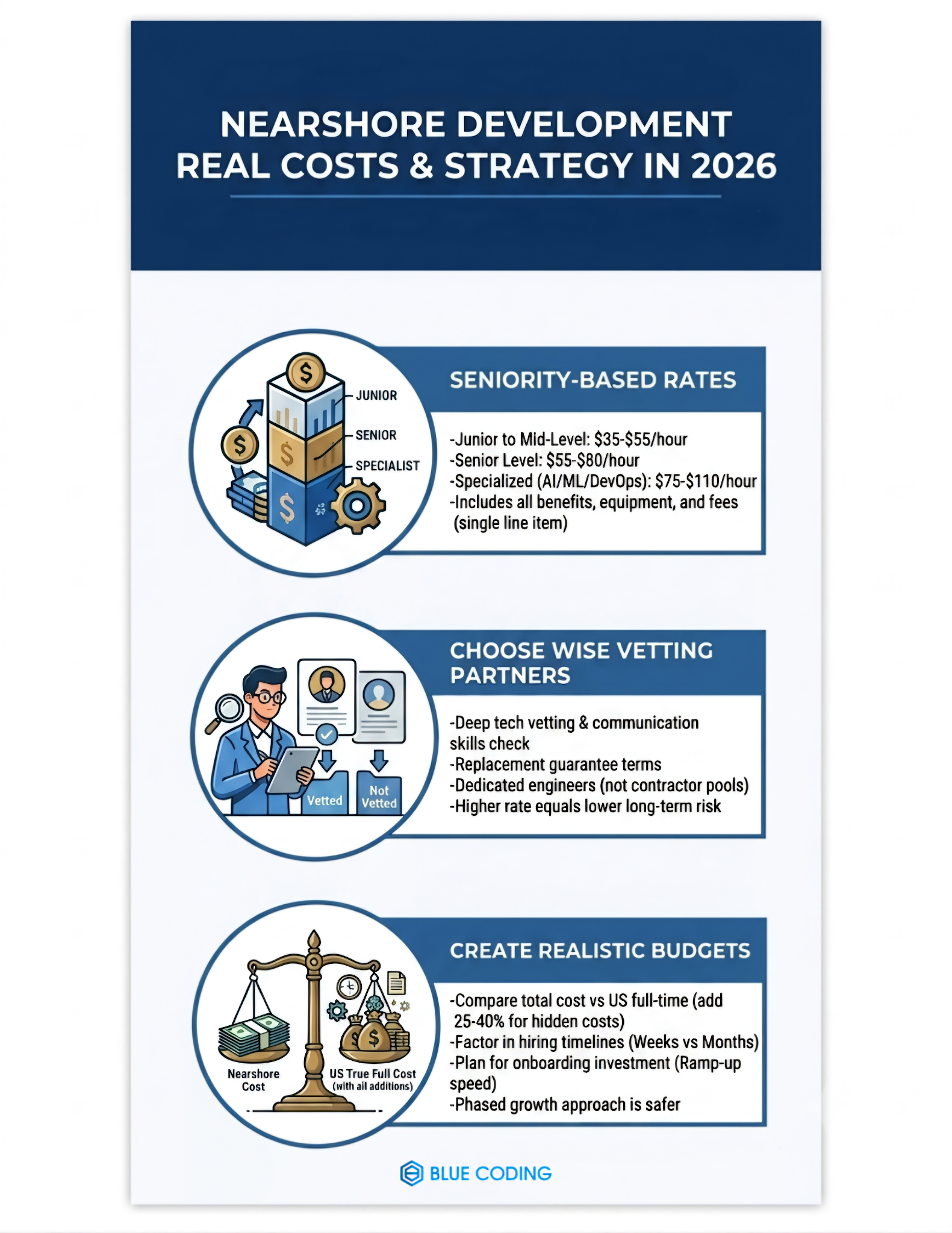
Nearshore developer rates in Latin America in 2025 typically fall into recognizable bands by seniority. Junior to mid-level engineers with two to four years of experience generally range from 35 to 55 dollars per hour. Senior engineers with five or more years of experience and demonstrated ownership of complex systems range from 55 to 80 dollars per hour. Specialized roles, including AI and machine learning engineers, senior architects, and DevOps specialists with deep cloud infrastructure expertise, can range from 75 to 110 dollars per hour depending on the specific skill set and demand.
These ranges vary by country as well. Argentina and Brazil tend to sit at the higher end of the range due to strong senior talent density and currency dynamics. Colombia, Mexico, and other countries with growing tech ecosystems often offer comparable quality at slightly lower rates, though the gap has been narrowing as demand for LATAM talent increases across the board. The most important thing to understand about these rate ranges is that they represent the full cost of the engagement in most well-structured staff augmentation models. There is no separate line item for benefits, payroll taxes, equipment, office space, or recruiting fees the way there would be with a full-time US hire. The hourly or monthly rate is the cost.
Two nearshore partners can quote significantly different rates for what looks like the same role on paper, and the difference is rarely random. The depth of the vetting process, the level of ongoing account management and support, the replacement guarantee terms, and whether the partner is providing dedicated long-term engineers versus rotating contractor pools all factor into pricing.
A lower rate from a partner with minimal vetting and no replacement guarantee is not actually cheaper once you account for the risk of a poor placement, the management overhead of working with an under-vetted engineer, and the cost of restarting the search if the engagement does not work out. Comparing nearshore staff augmentation pricing purely on the headline rate, without accounting for what is included in that rate, is one of the most common mistakes companies make when evaluating partners.
For a closer look at how to structure a nearshore engineering budget that accounts for these variables, Blue Coding's post on building a nearshore dev team according to your budget covers the practical planning process in detail.
When companies compare the cost to hire nearshore developers against US hiring, they frequently compare nearshore rates against base salary alone. That comparison understates the true cost of a US hire significantly. Payroll taxes, healthcare and benefits, equipment, recruiting costs, and the overhead of running a larger domestic HR and payroll function all add to the real cost of a full-time US engineer, typically adding 25 to 40 percent on top of base salary.
When you build the full cost comparison, a senior US engineer at 180,000 dollars in base salary often represents a true annual cost to the company of 230,000 to 250,000 dollars once these additional costs are included. The equivalent senior nearshore engineer at 65 dollars per hour, working a standard full-time schedule, costs approximately 135,000 dollars annually inclusive of the partner's vetting and support services. That is a cost reduction of 40 to 60 percent for comparable seniority and output quality.
A cost analysis that only looks at compensation misses one of the largest cost variables in any hiring decision: time. A US senior engineering hire typically takes three to five months from job posting to start date. During that period, the capacity gap the role was meant to fill remains unaddressed, which has its own cost in delayed delivery, missed roadmap milestones, and the opportunity cost of work that does not get done.
Nearshore staff augmentation from a partner with a pre-vetted bench typically compresses this timeline to two to four weeks from initial conversation to an engineer actively contributing. That difference in time-to-capacity is not reflected in the rate comparison, but it is a real and often underweighted part of the total cost calculation.
For a deeper breakdown of how this cost savings compounds across a full engineering team, Blue Coding's post on how hiring LATAM developers helps you save money on IT costs walks through the specific numbers.
A realistic nearshore staffing budget accounts for the fact that the first two to four weeks of an engagement will have somewhat lower velocity as the engineer onboards into your systems and processes. This is not unique to nearshore engineers. It is true of any new hire. The difference is that with nearshore augmentation, the ramp period is typically faster because the engineer has already been vetted for the role-specific skills and the onboarding process can be more structured from day one.
Budgeting for a modest reduction in expected output during the first month, rather than assuming full velocity from day one, produces more accurate financial planning and prevents the disappointment that comes from comparing month-one output against month-six output.
The cheapest nearshore staff augmentation pricing on the market is rarely the best value. Partners who undercut on price typically do so by skimping on technical vetting, English communication assessment, or ongoing account management. The engineers placed through these lower-cost arrangements often require more management overhead from your team, which is itself a cost that does not appear on the invoice.
When you are comparing pricing across nearshore partners, weight the comparison by what is actually included. A partner that charges 15 percent more but delivers a thorough vetting process, a clear replacement guarantee, and active account management throughout the engagement is frequently the better financial decision once the full cost of a poor placement is accounted for.
Several straightforward ways to reduce overall development costs without sacrificing quality are covered in our post on six ways to save money on development costs, which is useful context when you are building out your 2025 engineering budget.
Staff augmentation pricing scales with the size and duration of the engagement, but it does not need to be an all-or-nothing decision. Many companies start with one or two engineers to evaluate a partner's quality and process before scaling up to a larger dedicated team. This phased approach lets you validate the partnership with a smaller budget commitment before expanding it across more of your engineering needs.
Budgeting realistically means accounting for this phased growth rather than committing to a large team size upfront before you have evidence of how well the partnership is working in practice.
According to Statista's research on IT outsourcing, the global IT outsourcing market is projected to surpass 800 billion dollars by 2027, with cost efficiency and access to specialized talent cited as the two most common drivers behind that growth. Nearshore staff augmentation sits at the center of that shift for US companies specifically because it delivers both of those benefits without the time zone and communication tradeoffs of traditional offshore arrangements.
Understanding the real cost structure, not just the headline rate, is what allows engineering leaders to build a budget that accurately reflects what nearshore staff augmentation will deliver and make the case to finance and leadership with numbers that hold up to scrutiny.
For a broader view of how to measure the return on a nearshore partnership beyond just the cost savings, Blue Coding's comprehensive guide to measuring ROI in nearshore partnerships is worth reading as you build your full business case.
Blue Coding is a nearshore software development and tech staff augmentation company that gives US businesses transparent pricing based on actual role requirements, not vague rate ranges. We will walk you through exactly what a senior, English-proficient engineer from Latin America costs for your specific needs and how that compares to your current hiring options. We offer a free first call with no commitment. A direct conversation about your engineering budget, your capacity needs, and what a transparent, accurate cost comparison actually looks like for your situation. Book your free call with Blue Coding now!


Subscribe to our blog and get the latest articles, insights, and industry updates delivered straight to your inbox