The senior developer shortage in the US is structural and it is not closing. Here is how nearshore hiring gives US companies access to the senior engineering talent their domestic market cannot supply.


.svg)
.svg)
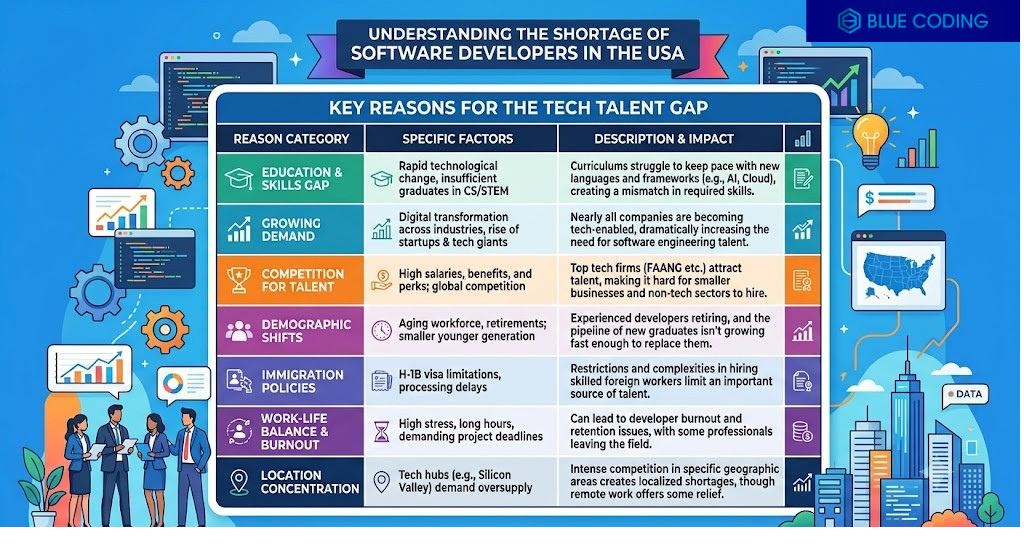
The senior developer shortage in the US is not a temporary market condition. It is a structural gap between the rate at which engineering demand is growing and the rate at which the domestic talent pipeline is producing senior engineers. Companies that are waiting for the market to correct are going to be waiting for a long time, and their roadmaps are going to show it.
Nearshore hiring has become the most operationally effective response to this shortage for mid-size and growth-stage US tech companies. Not because it is a compromise, but because the talent pool available through Latin America in 2025 includes the kind of senior engineering depth, the architects, the AI specialists, the engineers who can own technical decisions and mentor the team around them, that US companies are failing to find domestically.
This post explains why the shortage is structural, why nearshore hiring specifically addresses it rather than just working around it, and what the practical path looks like for companies ready to make that move.
According to the US Bureau of Labor Statistics, software developer employment is projected to grow 25 percent through 2032, nearly four times faster than the average across all occupations. The domestic talent pipeline is not growing at a rate that comes close to matching that demand trajectory. The gap is widening, not narrowing.
Senior engineering talent, the engineers with eight or more years of production experience who can own architecture decisions, mentor junior developers, and ship without heavy oversight, takes a decade to produce. University graduation rates in computer science have grown but not fast enough to keep pace with the demand growth created by digital transformation across every industry. The compounding effect of this gap means that the shortage of senior engineers available in the US market right now reflects demand growth from ten years ago, and the demand today is larger still.
Companies that have been trying to solve this by paying more are discovering that higher compensation pulls candidates away from competitors but does not create new senior engineers. The pool does not expand because salaries rise. It expands when engineers with three years of experience get the opportunities and mentorship that turn them into engineers with eight years of experience. That process takes time that most product roadmaps do not have.
The visible consequence of the senior developer shortage is not always a hiring failure. More often it is a quiet degradation of engineering quality caused by mid-level engineers being stretched into senior roles before they are ready. Architectural decisions get made by engineers who lack the depth to see the long-term implications. Technical debt accumulates because nobody with sufficient seniority has the bandwidth to address it. Code review becomes perfunctory because the people who should be reviewing carefully are too deep in their own delivery work.
The cost of this shows up not in a single quarter but in the compounding technical debt, the reliability issues, and the architectural rework that becomes unavoidable eighteen months later. Companies that stretch their mid-level team to cover a senior shortage today are often paying for it across a full year of engineering complexity that should not have existed.
The structural dynamics driving this shortage and why IT firms are increasingly turning to augmented team models rather than continuing to compete in the domestic senior market are documented in this look at why IT firms are augmenting dev teams in 2026.
The framing of Latin America as a source of affordable junior talent is a decade out of date. Countries like Argentina, Colombia, Brazil, and Mexico have produced generations of senior engineers who have built and maintained production-scale systems, led technical teams, made architectural decisions under real constraints, and developed the kind of judgment that only comes from years of actual production engineering work.
Buenos Aires alone has a concentration of senior AI and full-stack engineers that rivals major US tech hubs in depth if not in volume. Bogota and Medellin have produced strong senior engineering communities with high English proficiency and direct experience working in US engineering cultures. These are not junior developers made affordable by currency exchange. They are senior engineers in full demand globally who happen to cost significantly less than their US counterparts.
The objection to nearshore senior engineers used to be that remote senior developers could not fully participate in the architectural conversations, the ad hoc design sessions, and the real-time decision-making that define how senior engineers actually create value. That objection applies to offshore arrangements with a 12-hour time gap. It does not apply to Latin America.
A senior engineer in Bogota working with a team in New York operates in the same time window. They can be the first person in a morning architecture discussion. They can respond immediately when a production incident needs senior judgment. They can mentor a junior engineer through a complex debugging session in real time during the working day. The time zone alignment makes senior nearshore engineers operationally present in a way that offshore arrangements structurally cannot replicate.
The specific operational advantages that nearshore senior developers bring to US teams, and why those advantages compound over time as the engineering relationship matures, are covered in this breakdown of how nearshore partnerships solve the senior developer shortage.
Senior nearshore engineers from Latin America typically cost 40 to 60 percent less than equivalent US-based engineers in total engagement cost. For a company that was planning to hire two US-based senior engineers, that cost structure means it can hire three or four nearshore senior engineers at the same budget. That is not a cost reduction. It is a capacity expansion that the original budget could not have funded through domestic hiring.
The compound effect of this is significant. A team that would have added two senior engineers domestically in 2025 instead adds four senior engineers nearshore, covering more of the codebase with senior ownership, producing more rigorous code review, enabling faster mentorship of junior developers, and reaching the architectural stability that the team needed faster than the two-hire domestic approach would have allowed.
Why business services firms specifically are moving toward nearshore AI engineering for senior roles, and what that shift looks like in practice, is examined in this look at why business services firms are hiring nearshore AI engineers.
Companies making the transition from domestic to nearshore senior hiring often spend their first few weeks running the wrong process. They treat a nearshore engagement like an international LinkedIn search, posting requirements and waiting for applications, rather than engaging a partner with an established LATAM engineering network who can surface pre-vetted senior candidates within days.
The reframe that makes the process efficient is treating the nearshore partner as the sourcing infrastructure rather than trying to recreate domestic sourcing in a new geography. A partner with a maintained senior engineering bench in Colombia, Argentina, and Mexico has done the relationship-building and vetting work that makes rapid senior placement possible. That is the asset that makes the timeline difference.
The same vetting discipline that senior domestic hiring requires applies to nearshore senior hiring. Years of experience and genuine seniority are not the same thing. A thorough technical interview for a nearshore senior hire should include system design assessment, architectural tradeoff discussion, and a real-time conversation about past production decisions and their consequences. Those dimensions reveal genuine seniority in ways that coding tests and resume reviews cannot.
Partners who have built their senior vetting process around these dimensions can produce candidates who are genuinely senior in ways that translate into the team-level impact that senior engineers are supposed to create. Partners who vet primarily on stack familiarity and years listed on a resume are producing mid-level engineers with senior titles.
The shortage is structural. Engineering demand has grown faster than the domestic talent pipeline can produce senior engineers, who require eight or more years of production experience to develop. Higher compensation pulls candidates between companies but does not expand the pool. The gap has been widening for a decade and is projected to continue widening through 2032 based on current employment growth projections from the Bureau of Labor Statistics.
All seniority levels, including genuine senior depth. Argentina, Colombia, Brazil, and Mexico have produced engineers with ten or more years of production experience in modern stacks, AI engineering, complex distributed systems, and architectural leadership roles. The senior talent pool in LATAM is larger and deeper than most US companies realize when they approach the region with an outdated assumption that it is primarily a source of junior or mid-level capacity.
With a partner that has a genuine pre-vetted senior bench, the timeline from requirement submission to first candidate presentation is 24 to 48 hours for roles with strong LATAM talent density. Technical interviews and cultural fit assessments typically complete within a week. An engineer can be onboarded and contributing within two to four weeks of a signed agreement. That timeline compares to three to five months for an equivalent domestic senior hire.
For the specific roles most companies are trying to fill, yes. Senior engineers in Argentina, Colombia, Brazil, and Mexico who have built careers working with US product teams are proficient in the same modern stacks, familiar with US engineering culture and agile practices, and capable of the architectural ownership and mentorship that define senior engineering value. The quality difference that existed a decade ago has largely closed as LATAM engineering communities have matured and as the engineers in those communities have accumulated the production experience that seniority requires.
Blue Coding connects US tech companies with senior, English-proficient engineers from Latin America who are pre-vetted for technical depth, communication quality, and the architectural judgment that makes a senior hire worth the investment. Our bench covers the senior talent in Argentina, Colombia, Brazil, and Mexico that your domestic recruiting process cannot reach.
We offer a free first call with no commitment. A direct conversation about the senior engineering gap you are trying to close and whether we have the right candidates available to close it.
Book your free call with Blue Coding


Subscribe to our blog and get the latest articles, insights, and industry updates delivered straight to your inbox