Speed and stability can coexist. Explore how to boost software delivery speed through development quality assurance and smarter team structures. Build a workflow where high quality is a natural byproduct of your process.


.svg)
.svg)
The software market is moving faster than ever, and the pressure to ship is constant. However, rushing to meet a deadline often leads to technical debt that crashes the system later. Industry forecasts suggest that by 2027, AI-driven development workflows will allow teams to increase their software delivery speed by up to 40% while simultaneously reducing manual coding errors. This shift means that the old trade-off between moving fast and staying stable is disappearing. You no longer have to choose one over the other; you just need a better system to handle both.
Many teams think that delivering faster just means working longer hours. That is a mistake. Working more hours leads to burnout and more bugs, which actually slows you down in the long run. Real speed comes from removing the friction in your daily workflow. It is about working smarter by focusing on high-impact tasks and automating the boring stuff. When you optimize your pipeline, you create an environment where how to deliver software faster without sacrificing quality becomes a natural outcome of your process rather than a stressful goal.
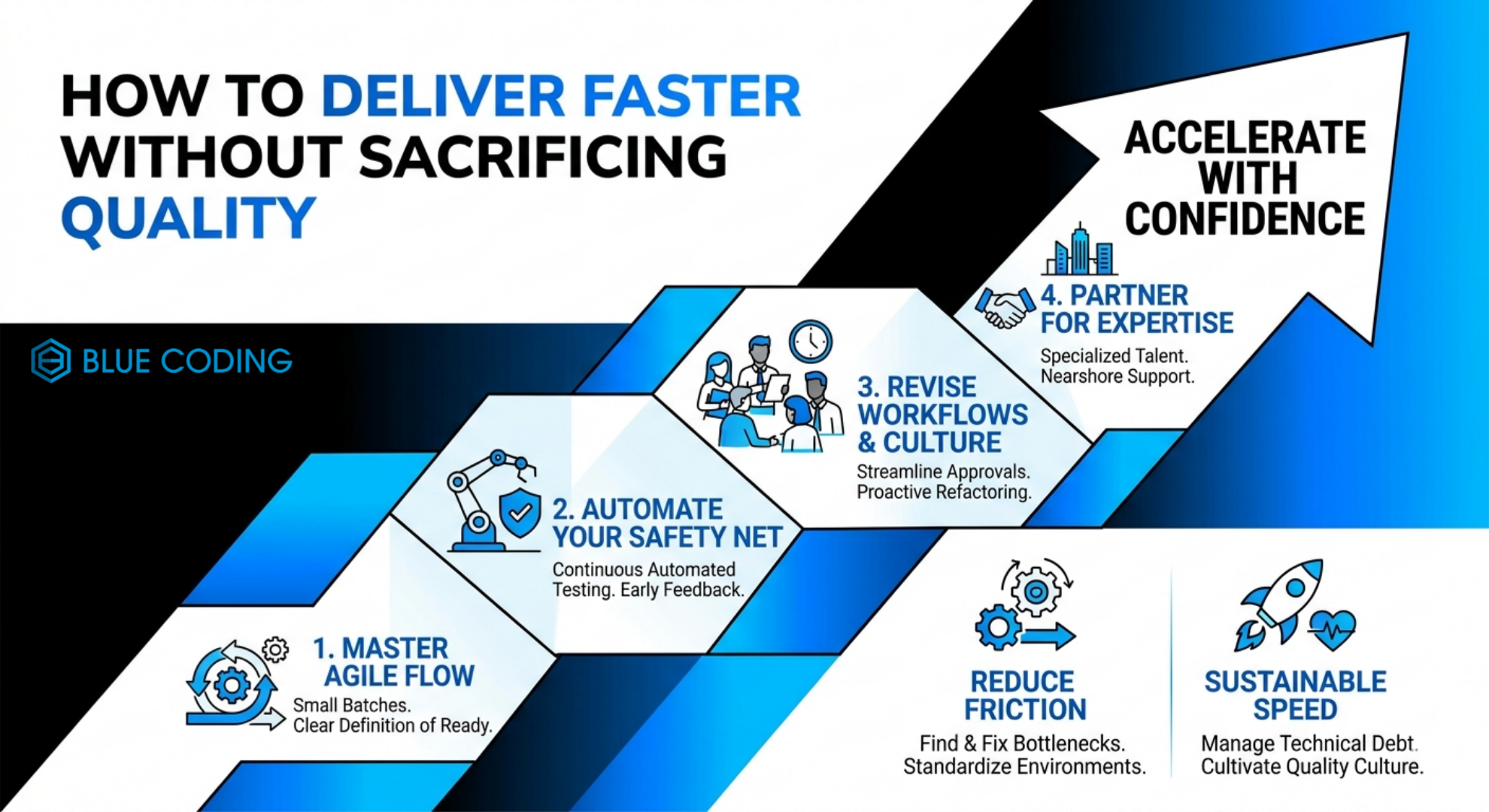
To stay competitive, you must lean into agile development best practices. This does not just mean having a daily meeting; it means breaking large, scary projects into tiny, manageable pieces.
You cannot have speed without a solid foundation of development quality assurance. If your testing is manual, it will always be a bottleneck. Automated testing is like having a security guard that never sleeps. It checks every line of code as it is written, ensuring that a new feature does not break an old one. This gives your team the confidence to push code multiple times a day. When the system handles the repetitive checks, your human experts can focus on complex problem-solving.
Sometimes, the hurdle isn't your process, but your capacity. Nearshoring or staff augmentation can bring in experts who already know the latest tools and frameworks. Instead of spending months hiring and training, you get a plug-and-play team that understands how to maintain high standards under tight deadlines. This allows your core team to focus on the big-picture strategy while the additional hands help accelerate the build.
A common speed killer is that it works on my machine problem. If every developer has a different setup, you will waste hours debugging environment issues. Using tools like Docker or cloud-based development environments ensures that everyone is playing by the same rules. When the development, staging, and production environments are identical, moving code through the pipeline becomes seamless and predictable.
In the past, security was something you checked right before a product went live. If a problem was found, it meant weeks of delays. By shifting left, you integrate security and quality checks at the very beginning of the coding process. This proactive approach saves time because it is much cheaper and faster to fix a vulnerability while the code is still being written than it is to patch a finished product.
You cannot improve what you do not measure. Use tools to track your cycle time, the time it takes for an idea to go from a task to live code. Look for where the work gets stuck. Is it waiting for a code review? Is it stuck in the testing phase? Once you see the data, you can stop guessing and start fixing the specific parts of your workflow that are dragging you down.
Quality is not just the job of the QA team; it is everyone’s responsibility. When developers take pride in writing clean, readable code, the entire organization moves faster. Encourage pair programming and thorough peer reviews. These habits might feel like they take extra time at first, but they prevent the massive time-sinks caused by fixing deep-rooted architectural errors six months later.
Complexity is the enemy of speed. If your team is juggling too many different languages, libraries, and tools, they will spend more time managing the stack than building features. Look for ways to simplify. Consolidate your tools and stick to proven frameworks that have strong community support. A leaner stack is easier to maintain, easier to secure, and much faster to scale.
There is no finish line for efficiency. The best software teams are always looking for small ways to get better. This kaizen approach ensures that your processes evolve as your team and technology change. By focusing on agile development best practices and investing in development quality assurance, you build a sustainable engine for growth.
Ultimately, knowing how to deliver software faster without sacrificing quality is about balance. It is about using the right tools, the right people, and the right mindset to create value. When you stop rushing and start optimizing, you’ll find that high speed and high quality are actually two sides of the same coin. Your users get better features sooner, and your team stays motivated and focused.
To truly master software delivery speed, companies must look at the entire lifecycle of a feature. It is not just about how fast a developer can type. It involves the time spent in discovery, the clarity of the ticket, the efficiency of the CI/CD pipeline, and the speed of the deployment itself. If any of these links are weak, the whole chain slows down.
For example, many organizations suffer from overly complex approval processes. If a developer finishes a feature in two hours but it takes two days for a manager to approve the pull request, your actual delivery speed is slow. Streamlining these administrative hurdles is just as important as writing clean code.
While many teams ignore documentation in the name of speed, this is a trap. Poor documentation leads to knowledge silos. When only one person knows how a specific module works, they become a bottleneck. By maintaining clear, simple, and updated documentation, you ensure that any team member can jump in and help. This flexibility is a core component of agile development best practices because it prevents projects from grinding to a halt when a key person is unavailable.
Technical debt is inevitable in any fast-moving project. The key is to manage it like a financial loan. You can take on debt to meet a critical deadline, but you must have a plan to pay it back. High-performing teams dedicate a certain percentage of every sprint to refactoring and clearing debt. This prevents the code from becoming so messy that future development slows to a crawl. Investing in development quality assurance means keeping the codebase healthy enough to support rapid changes long into the future.
Moving from a monolithic architecture to microservices or serverless functions can also provide a massive boost. When a system is modular, teams can work on different components simultaneously without stepping on each other's toes. This separation of concerns allows for independent deployments, meaning one small change doesn't require a full system reboot. It is one of the most effective technical answers to how to deliver software faster without sacrificing quality.
Fast delivery is a marathon that requires a culture of excellence over shortcuts. By prioritizing development quality assurance and agile development best practices, you transform speed into a byproduct of a healthy workflow rather than a result of pressure. At Blue Coding, we build high-performing teams and scalable software that help you maintain this balance. We connect businesses with top-tier technical talent to ensure every project meets the highest standards while navigating complex technical challenges. Whether you need to improve your software delivery speed or refine your tech stack, we are here to support your growth. We offer a first free call for any queries you have about scaling your team. Contact us today to arrange your call!


Subscribe to our blog and get the latest articles, insights, and industry updates delivered straight to your inbox