Full-time or staff augmentation? The answer depends on four variables most engineering leaders skip. Here is the practical framework to get it right.


.svg)
.svg)
Every engineering leader hits the same decision point at some stage. The team needs to grow. The question is how. Full-time hiring and staff augmentation are not competing philosophies. They are different tools for different situations, and the leaders who understand that distinction clearly make better resourcing decisions faster than the ones who treat every capacity gap the same way.
This post is a practical guide to that decision. Not a theoretical one. If you are sitting with an open role, a growing backlog, or a product timeline that does not have enough engineers behind it, this breakdown is designed to help you think through which approach actually fits your situation. According to a McKinsey Global Institute report on the future of work, up to 25 percent of the workforce in advanced economies may need to switch occupations by 2030 due to the pace of technology change. For engineering leaders, that number is a signal. The workforce structures that worked five years ago are not necessarily the right ones for the next five. How you build your team is as much a strategic question as what you build with it.
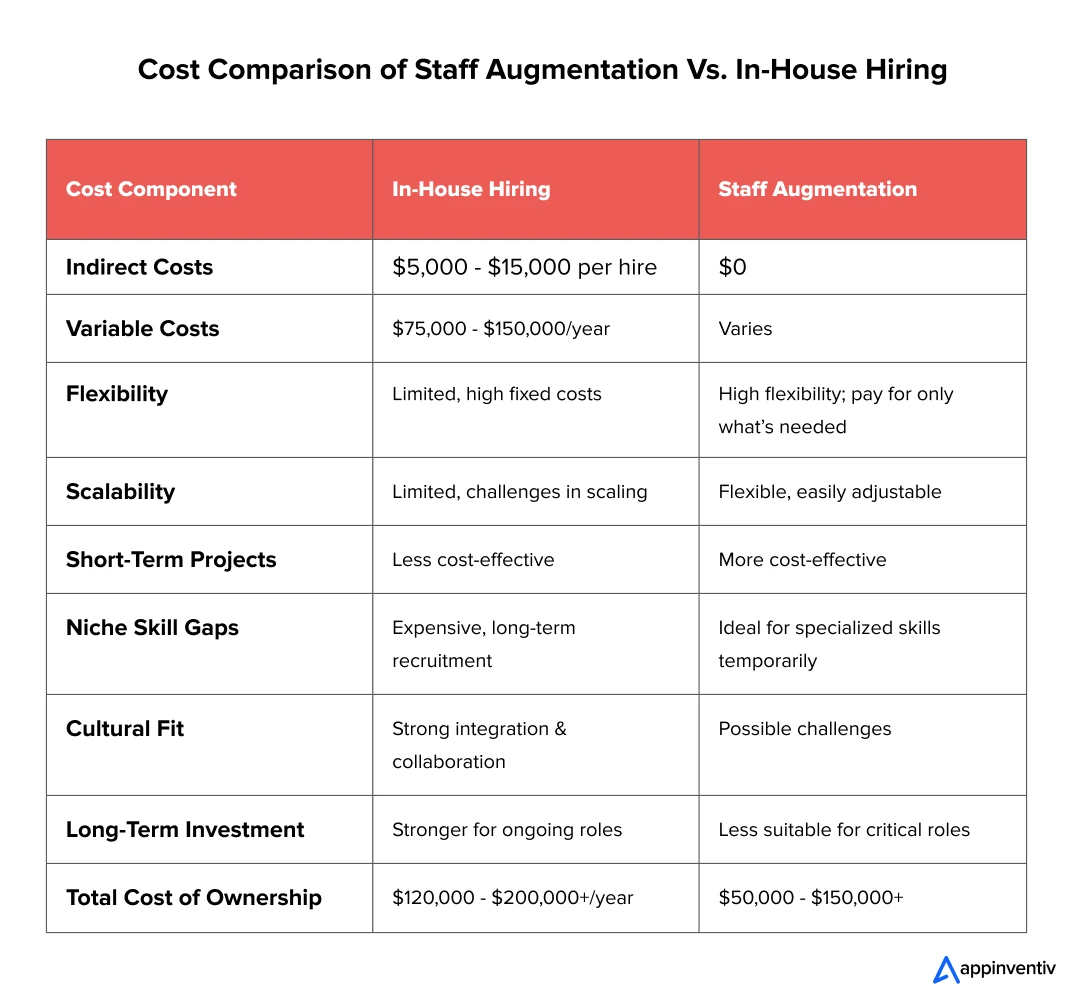
Most articles that compare staff augmentation vs full-time hiring reduce the decision to a cost comparison. Staff augmentation costs more per hour. Full-time hiring costs more in total with benefits and overhead. Pick the cheaper one.
That framing misses the actual decision. Cost is one variable in a much larger equation. The real question is what kind of engineering capacity you need, for how long, and how deeply it needs to be integrated into your team to be effective. A full-time hire makes sense when you need someone who will own a function, build institutional knowledge, and grow with the product over multiple years. Staff augmentation makes sense when you need specific capacity at a specific time without the organizational overhead that comes with permanent headcount.
Getting that diagnosis right is what separates engineering leaders who build efficient, high-performing teams from the ones who either carry too much permanent overhead or cycle through augmented engineers who never fully integrate.
Before you decide which model to use, four questions are worth answering honestly:
Certain engineering roles carry ownership that goes beyond technical execution. Principal engineers, technical leads, and platform owners are building the architecture decisions, the engineering culture, and the institutional knowledge that an organization depends on over years. These are not seats you fill temporarily. When the role is fundamentally about long-term ownership, a full-time hire is the right structure. The investment in recruiting, onboarding, and retention pays off because the value compounds over time in ways that a rotating augmented engineer cannot replicate.
Early-stage engineering teams need founders, not contractors. The engineers who define the initial architecture, establish the technical culture, and set the standards for everything that gets built afterward need to be genuinely committed to the organization. That commitment is much harder to secure and sustain in an augmented model. If you are building the first ten engineers on a product team, most of those hires should be full-time. The institutional context they build together in that period becomes the foundation for everything that scales on top of it.
Some technical skill sets are so specific to your product that the ramp time for any new engineer would be prohibitive in a rotating model. If you have a highly customized internal platform, a proprietary data architecture, or a domain-specific technical context that takes months to absorb, the economics of augmentation stop making sense. The ramp cost becomes too high relative to the contribution window.
The clearest case for staff augmentation is a specific need with a specific end. A product launch that requires three extra engineers for six months. A front-end overhaul that the current team does not have bandwidth for. A data migration project that requires skills nobody on the team carries. In these situations, staff augmentation for engineering teams delivers exactly what you need without the organizational overhead of hiring someone into a role that will not exist at the same scope in a year. The engineers contribute, the work gets done, and the team scales back without a restructuring conversation.
This is the scenario most engineering leaders underweight. You know you need more capacity. You start a search. Three months in, you have interviewed twelve candidates, made two offers, had one rejected and one accepted. The engineer starts six weeks later. You are now five months into a gap that was urgent in month one.
Staff augmentation from a partner with a ready bench compresses this entire timeline. From identifying the need to having an engineer in your standup, you are measuring weeks rather than months. For companies with quarterly planning cycles and real delivery pressure, that compression is the difference between hitting a target and missing it. For a closer look at the structural dynamics that make this timing problem so persistent, Blue Coding's post on the hidden costs of traditional IT recruiting covers exactly what gets lost in a slow hiring cycle.
Your backend team is strong but nobody owns mobile. Your product roadmap has a six-month initiative that is heavily iOS-dependent. Hiring a full-time iOS engineer for a six-month project means carrying that headcount long after the initiative wraps, or going through the difficult process of letting someone go when the work winds down.
Staff augmentation lets you add the expertise precisely when you need it and right-size the engagement as the roadmap evolves. That flexibility is not just financially efficient. It is also organizationally cleaner. You are not making permanent structural decisions based on temporary capacity needs.
According to the Project Management Institute, organizations that build flexible workforce strategies outperform those with rigid headcount models on project delivery speed by a significant margin. When your priorities shift between quarters, a team composed entirely of permanent headcount has a structural lag in responding. Staff augmentation for engineering teams gives you a layer of capacity that can flex with those shifts rather than against them.
The most effective engineering team structure for most growth-stage companies is not a pure full-time team or a pure augmentation model. It is a permanent core with a flexible augmented layer.
The permanent core holds architecture ownership, product context, and engineering culture. The augmented layer provides capacity flexibility, skill set coverage for specific initiatives, and the ability to accelerate delivery during high-demand periods without over-hiring for normal-state operations.
This structure lets you maintain the institutional depth that a full-time team builds while retaining the operational flexibility that a growing company needs to respond to changing priorities. The key is being deliberate about which roles belong in each category rather than defaulting to one model for everything.
A useful mental model: if a role is primarily about knowing the product deeply and making decisions that will affect the team for years, it belongs in the permanent core. If a role is primarily about executing well-defined work within a defined scope, it is a candidate for the augmented layer.
Most engineering teams have more roles in the second category than they realize. And filling those roles with permanent headcount when augmentation would serve them equally well is one of the most common sources of unnecessary overhead in growing tech organizations.
For a practical framework on how different hiring models map to different company growth stages, Blue Coding's breakdown of what distinguishes staff augmentation from direct hire arrangements goes into the operational differences in detail.
Whichever model you choose, the quality of execution depends on who you work with to do it. For full-time hiring, that means your internal recruiting capability or the search firms you engage. For staff augmentation, it means the partner you trust to source, vet, and place engineers who can integrate effectively into your team.
The most common failure mode in staff augmentation is not the model itself. It is a partner who does not vet deeply enough, does not assess communication quality alongside technical skill, and does not stay engaged after placement to make sure integration actually happens.
For a detailed look at what the best IT staff augmentation services actually include, Blue Coding's post on what to consider when choosing a staff augmentation provider is worth reading before you evaluate options. The right partner makes staff augmentation genuinely effective. The wrong one makes you conclude that the model does not work when really the execution was the problem.
Blue Coding partners with engineering leaders at growing US tech companies to provide nearshore staff augmentation that delivers pre-vetted, English-proficient engineers from Latin America who integrate into your team and contribute from week two. We work with both models. We help companies figure out which one fits their situation and execute the augmentation side with the depth of vetting and the integration support that makes the difference between an engineer who contributes immediately and one who spends their first month getting oriented.
We offer a free first call with no commitment. A direct conversation about your capacity situation, your timeline, and whether augmentation, a hybrid model, or something else entirely is the right fit for where your team is right now. Book your free call now with Blue Coding!


Subscribe to our blog and get the latest articles, insights, and industry updates delivered straight to your inbox