Not every engineering capacity problem needs a full augmented team. Here is how to figure out whether one remote developer or a dedicated pod is the right call for your situation.


.svg)
.svg)
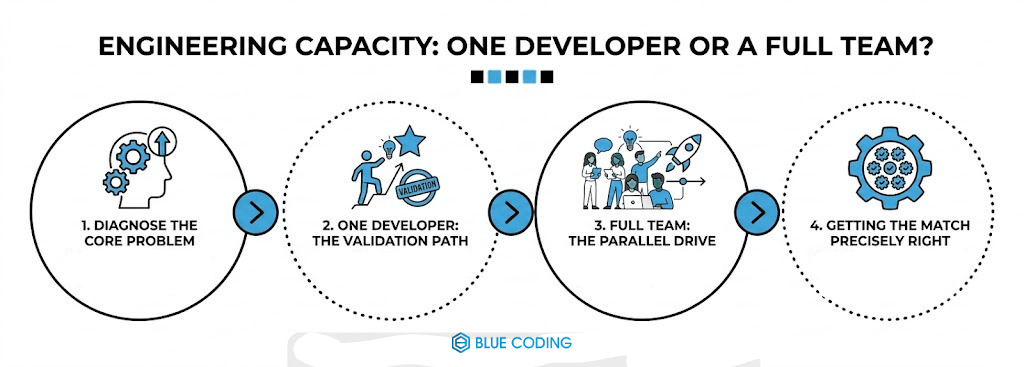
The decision to augment your engineering team is usually straightforward. The decision about how much augmentation you need is where most companies go wrong. Some over-hire, bringing in a full team for a problem that one strong engineer could solve. Others under-hire, placing one developer against a capacity gap that requires a coordinated pod to close. Both produce disappointing outcomes for different reasons.
Getting this right starts with an honest diagnosis of what the actual problem is. Is the issue a specific skill gap? A bandwidth constraint? A parallel workstream that the current team cannot run while maintaining delivery on the primary roadmap? Or a structural under-staffing that has been building for multiple quarters? Each of these has a different answer when it comes to whether one developer or a full augmented team is the right response.
This post walks through the diagnostic framework for making that call clearly, with specific indicators for each scenario and guidance on how to structure the engagement once the decision is made.
According to Project Management Institute research on engineering capacity, misaligned team size is one of the leading contributors to project delivery failure, with teams that are both over-staffed and under-staffed reporting worse delivery outcomes than those with capacity precisely matched to scope. Getting the size right is not a secondary concern. It is foundational to whether the engagement actually solves the problem.
The clearest case for a single augmented developer is a specific technical skill that does not exist on the current team and is needed for a defined scope of work. Your backend team is strong but nobody owns mobile. You have a data engineering initiative that requires Python and PySpark depth that none of your current engineers have. Your DevOps setup needs a Kubernetes specialist for a three-month infrastructure overhaul.
In each of these cases, the gap is a skill gap, not a headcount gap. Adding more engineers without the specific skill does not solve the problem. Adding one engineer with exactly the right capability does. A single well-matched senior developer in this context frequently produces more useful output than a larger team of generalists because the problem is specialized and the solution requires specialization.
A single augmented developer works well when the scope of work has clear boundaries and does not require constant coordination with multiple other people to make progress. A well-documented API integration, a defined refactoring project, a specific performance optimization initiative, or a mobile feature build with a finished design spec all have the structure that allows a single senior engineer to operate with meaningful autonomy.
When the work is deeply entangled across multiple systems, requires daily coordination with five different stakeholders, or has unclear scope that shifts every sprint, a single developer spends more time on coordination overhead than on delivery. That is a signal the problem may need a different team structure rather than a single additional engineer.
Starting with one developer is also the right move when a company is engaging with nearshore staff augmentation for the first time and wants to validate how well the model works with their specific team before committing to a larger engagement. A single well-chosen engineer is a low-risk way to evaluate the partner's quality, assess how nearshore integration works with your processes, and identify any onboarding or communication patterns that need to be addressed before scaling up.
Understanding why cultural fit is especially important in a single-developer augmentation engagement, where the integration surface is smaller and misalignment is more immediately disruptive, is covered in this breakdown of why cultural fit matters in nearshore staff augmentation.
The strongest case for a full augmented team is when your roadmap requires two tracks of work to run simultaneously and your current team can only sustain one without compromising delivery quality on both. The core team continues on the primary product track. The augmented team owns the parallel workstream, whether that is a platform modernization, a new product area, a heavy infrastructure initiative, or a deadline-driven feature push.
A single developer dropped into a parallel workstream without supporting teammates is often in the worst possible position: expected to own an initiative independently without the colleagues they would need to architect, build, and review the work at the pace required. A coordinated pod of three to five engineers working as a unit is structurally more capable of owning a parallel workstream than a single augmented developer carrying the same scope.
When sprint velocity has been declining across multiple quarters, when the backlog is growing faster than the team can address it, and when roadmap features are being pushed every quarter not because priorities changed but because the team does not have the capacity to execute, the problem is structural under-staffing rather than a specific skill gap.
A structural velocity problem requires structural capacity addition. One developer adds one unit of capacity to a team that is already operating at or above sustainable load. A coordinated augmented team adds enough capacity to meaningfully change the throughput equation rather than just slightly reducing the deficit.
How different augmentation structures map to different company growth stages, and which model scales most efficiently for a Series A company versus a larger organization, is broken down in this comparison of staff augmentation and managed team models by growth stage.
Some engineering work benefits from the internal dynamics of a small dedicated team in ways that a single isolated developer cannot replicate. Code review across the pod, architectural discussion between team members, pair debugging on complex problems, and the compounding institutional knowledge that builds when the same engineers work together on the same system over time all require a team structure rather than an individual.
When the work is the kind that gets better from team-level collaboration, a full augmented team produces qualitatively different outcomes than a single developer. The team dynamic is not just a headcount difference. It is a structural capability difference.
What it means in practice for IT firms to augment their development teams rather than hire individually, and why the team-based augmentation model is becoming the dominant approach in 2026, is covered in this look at why IT firms are augmenting dev teams in 2026.
Is the problem a skill gap or a capacity gap? If a specific technical capability is missing, one developer with that skill usually solves it. If the team simply does not have enough hours to execute the roadmap, one developer rarely changes the throughput equation enough to matter.
Is the work self-contained or deeply integrated? Self-contained work with clear scope and minimal dependencies is well-suited to a single augmented developer. Work that spans multiple systems and requires constant team-level coordination performs better with a coordinated pod.
Does the work need to run in parallel with your current roadmap? If yes, a full augmented team is almost always the right answer, because a single developer added to an existing team does not create a parallel track, it adds marginal capacity to the existing one.
Is this your first nearshore engagement? If yes, starting with one developer is a sensible validation step before scaling the relationship.
When the capacity need is a specific skill gap rather than a headcount gap, when the work is self-contained with clear scope and minimal dependencies, and when the company wants to validate a nearshore partner before committing to a larger engagement. One well-matched senior developer in these scenarios frequently produces more useful output than a larger team of generalists.
Sprint velocity declining for three or more consecutive quarters without a scope-related cause, a backlog growing faster than the team can address it, a parallel workstream the current team cannot run without compromising primary roadmap delivery, or work that requires team-level code review and architectural collaboration rather than individual contribution.
Most effective augmented teams for mid-size US tech companies range from three to six engineers, structured around the scope and complexity of the workstream they are owning. Three engineers is typically the minimum for a functional pod with meaningful internal review and collaboration dynamics. Six to eight engineers is appropriate for larger parallel workstreams or AI pod structures with specialized roles. Beyond eight, the coordination overhead of a remote augmented team tends to offset the capacity gain unless the team has strong internal leadership.
Yes, and it is often the best approach for a company engaging with nearshore augmentation for the first time. One developer validates the partner's quality, surfaces integration patterns that need to be addressed, and builds the institutional context that makes adding further engineers faster and smoother. Most strong nearshore partners can scale from one engineer to a full pod within two to three weeks of a confirmed scale decision.
Blue Coding works with US engineering teams to match the right capacity model to the actual problem. We do not push full teams when one developer solves it, and we do not understaff when the scope requires a coordinated pod. We take the time to understand the specific need before making a recommendation, and we stand behind the placements we make with a clear replacement process.
We offer a free first call with no commitment. A direct conversation about what your team actually needs and which model, one developer or a full augmented team, is the right fit for the problem you are solving.
Book your free call with Blue Coding


Subscribe to our blog and get the latest articles, insights, and industry updates delivered straight to your inbox