Hiring a senior developer from Latin America in under two weeks is possible with the right process. Here is exactly how it works, what to prepare, and what to look for.


.svg)
.svg)
Hiring a senior developer from Latin America in under two weeks is not a marketing claim. It is a repeatable outcome when the right conditions are in place: a specific role brief, a nearshore partner with a genuine pre-vetted bench, and an internal process that moves decisions within 24 hours at each stage rather than letting reviews sit for days.
Most companies that take three months to hire a LATAM developer are not facing a talent availability problem. Latin America had over 1.4 million active software developers by 2025, according to the Inter-American Development Bank, with senior engineering talent concentrated in Argentina, Brazil, Colombia, Mexico, and Chile. The talent is there. The delays are almost always process delays, not availability delays.
This post walks through the exact steps to compress a nearshore hiring process into two weeks, what to have ready before you start, what to look for at each stage, and what actually determines whether the timeline holds.
According to SHRM research on time-to-fill for technical roles, the average time-to-fill for senior software engineering roles in the US reached 45 days in 2024. A nearshore process with the right partner and the right preparation structure consistently delivers in less than half that time.
A vague brief produces a slow search. A specific brief produces a precise match. The single biggest controllable cause of a slow nearshore hiring process is a role description that lists ten technologies without distinguishing must-haves from nice-to-haves, describes experience in years without describing what that experience should have produced, and gives no context on the team or the product the engineer is joining.
A brief that enables a two-week placement answers these questions precisely: what is the primary technical responsibility, which three to five technologies are non-negotiable, what does successful output look like in the first 30 days, what is the team structure this person joins, and what is the hardest problem they will face in the first quarter. That specificity lets a partner with an established bench run a targeted match rather than a broad search.
A two-week hiring timeline assumes the internal decision-making process moves as fast as the sourcing process. Before submitting a brief to any nearshore partner, confirm internally who the interviewers are, what the technical and cultural assessment format looks like, who holds final approval authority, and how quickly an offer can be extended once a candidate passes.
Each internal step should take no more than 24 hours. A brief that sits two days awaiting approval, a candidate profile reviewed over a long weekend, or an offer letter delayed by a legal review scheduled for next week each consume days from a timeline that has no slack in it. Compressing internal cycle times is as important as finding the right partner.
With a specific brief submitted to a partner that maintains a genuine pre-vetted bench, the first candidates surface within 24 to 48 hours. These are not cold profiles pulled from a resume database and sent without context. They are engineers who have already been technically assessed, evaluated on English communication, and matched against the specific requirements of the brief.
Review the profiles within 24 hours of receiving them and identify which warrant a first interview. A review that sits three days at this stage has already consumed 20 percent of the two-week target. Treat the candidate review with the same urgency you would treat a product blocker.
The technical interview for a senior hire should surface judgment, not just syntax. Structure it around system design: ask the candidate to walk through an architectural decision they made on a recent project, explain the tradeoffs they considered, and describe what they would do differently. That conversation reveals more about genuine seniority than any algorithmic coding test.
Run the cultural fit assessment as a separate conversation with one or two engineers from your existing team. Give the candidate honest context about how the team actually operates, what the hard parts of the role are, and how decisions get made. Their response tells you whether they will integrate well or create friction, which is as important as technical skill in a distributed team.
For companies deciding which LATAM country to source from based on technical specialization and talent density, the regional breakdown across this two-part guide to LATAM nearshoring by country is worth reading before the brief is submitted.
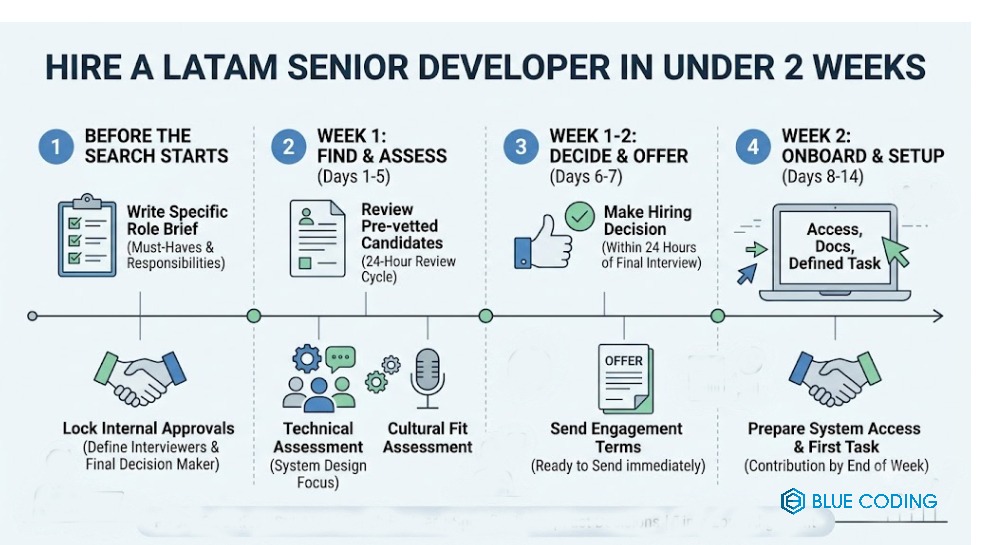
The hiring decision should happen within 24 hours of the final interview, not at the end of a deliberation week. Senior LATAM engineers in high demand do not wait weeks while a committee debates. A delayed decision signals operational slowness that itself is relevant information for a candidate deciding whether to join.
The offer for a nearshore augmentation engagement is structurally simpler than a full-time hire: rate, start date, engagement terms, and key expectations. Have the core offer ready to send within hours of a positive decision, not days. The gap between a verbal agreement and a signed offer is how strong candidates end up placed elsewhere.
The week between offer acceptance and start date is not downtime. It is the window that determines how fast the engineer becomes productive. Set up system access in advance. Prepare codebase documentation and architectural context. Define the first task with a clear scope and definition of done. Schedule introductions with the key team members they will be working with daily.
An engineer who starts Monday with access, context, a defined first task, and a planned first week contributes meaningfully by end of week two. An engineer who starts Monday and spends the week waiting on access approvals and orienting themselves independently is still ramping in week four regardless of their seniority.
The reasons LATAM engineers specifically integrate faster into US teams than equivalent talent from other regions, including time zone alignment, cultural familiarity with US engineering culture, and English proficiency at the professional level, are covered in detail in this breakdown of LATAM engineer integration speed.
Every element of a two-week nearshore hiring timeline depends on the partner having engineers who are genuinely available, genuinely assessed, and genuinely matched to the specific role. A partner operating from a resume database rather than a maintained bench cannot deliver on this timeline regardless of how efficient your internal process is. The first question to ask any nearshore partner before engaging them is not their rate. It is how many engineers they have available right now in the specific stack you need, when each was last assessed, and how quickly they can get you into a first interview.
For a broader view of the platforms and approaches US companies use to source LATAM engineering talent, this comparison of the top platforms to hire developers in Latin America covers the landscape in detail.
Yes, with the right conditions. A specific role brief, a nearshore partner with a genuine pre-vetted bench, and internal decision cycles that move within 24 hours at each stage make a two-week timeline consistently achievable. Most delays are process delays on the client side, not talent availability delays in the market.
Time zone overlap is the primary operational difference. Latin American developers work within zero to three hours of US time zones, enabling real-time standups, same-day code review cycles, and immediate availability for production incidents. Engineers in Southeast Asia or South Asia operate nine to thirteen hours removed from US teams, creating structural async delays regardless of individual talent level.
Focus on system design judgment and communication of technical tradeoffs rather than algorithmic speed tests. Senior developers show seniority through how they reason about architectural decisions, how they explain complex systems to non-technical stakeholders, and how they describe past failures and what they changed as a result. A 60-minute system design conversation reveals more about genuine seniority than a three-hour coding challenge.
Argentina leads for senior AI and full-stack engineering talent density. Colombia, particularly Bogota and Medellin, has a strong and growing mid-to-senior pool with high English proficiency. Brazil has the largest overall developer population with particular depth in fintech and data engineering. Mexico offers consistent quality with strong cultural alignment for US teams. Each country has distinct technical strengths worth matching against specific role requirements before the search begins.
Blue Coding maintains a genuine pre-vetted bench of senior, English-proficient engineers across Latin America. When you submit a specific requirement, you are selecting from engineers who have already been technically assessed and communication-tested, not waiting for a search to begin.
We have placed senior engineers from Latin America into US engineering teams in under two weeks consistently. The process works when the brief is specific, the internal decision cycle is fast, and the partner has done the vetting work in advance.
We offer a free first call with no commitment. A direct conversation about your role, your timeline, and whether we have the right engineers available to meet it. Book your free call with us now!


Subscribe to our blog and get the latest articles, insights, and industry updates delivered straight to your inbox