Build compliant software development teams in Latin America with this guide to financial services IT outsourcing and the BOT model for the finance sector.


.svg)
.svg)
The financial services landscape is currently facing a dual challenge. On one side, there is an urgent need for digital transformation to keep up with agile startups. On the other side, there is an increasingly complex regulatory environment that makes traditional outsourcing risky. For many leaders in the industry, the search for talent has moved beyond simply finding the lowest price. Instead, the focus is now on high-authority strategy and operational security. This is where the concept of nearshoring becomes a vital asset for modern banks and fintech firms.
By shifting focus to nearby regions, specifically within Latin America, companies can bridge the gap between internal capability and external scale. This approach moves away from the old model of staff augmentation and toward the creation of dedicated software pods. These pods are designed to operate as a seamless extension of the home office. When built correctly, they offer the speed and cultural alignment necessary to thrive in a competitive market.
For decades, the standard approach to scaling a tech team involved looking at distant markets with high volumes of workers. While this worked for back office data entry or simple maintenance, it often failed for complex financial products. The distance created more than just a time zone gap. It created a lack of context regarding local regulations and consumer behavior. In the current market, financial services IT outsourcing has evolved into a strategic partnership model. Modern firms now prioritize proximity. When your engineering team is only a few hours away by plane and operates in the same time zone, the friction of development disappears. Real-time collaboration allows for agile pivots and faster deployment cycles. This is particularly important for financial products where a delay of even a few hours in responding to a market change can result in lost revenue or security vulnerabilities.
The growth of the tech sector in Latin America has provided a unique opportunity for North American firms. Countries like Mexico, Colombia, Argentina, and Uruguay have invested heavily in technical education and infrastructure. This has created a massive pool of senior talent that understands the specific demands of the financial world.
Choosing nearshore fintech development allows companies to tap into this expertise without the headaches of traditional offshoring. These engineers often have experience working with global banks and understand the nuances of building high-performance systems. Whether it is implementing blockchain for secure transactions or building AI-driven credit scoring models, the talent in the region is equipped to handle high-stakes projects. Furthermore, the cultural alignment between the Americas ensures that communication is clear and that there is a shared understanding of business goals.
In the world of finance, compliance is not a checkbox. It is the foundation of the business. Any external team must be built with a security-first mindset. This is why the pod model is so effective. Instead of hiring isolated contractors, you build a structured unit that includes its own quality assurance and project management layers.
To build compliant software development teams, you must look beyond coding skills. Every member of the pod should be trained in the specific regulatory requirements of your target markets. This includes understanding standards like SOC2, PCI DSS, and GDPR. By integrating compliance experts directly into the development pod, you ensure that every line of code is written with security in mind. This reduces the risk of expensive reworks later in the process and ensures that the product is ready for the market from day one.
Technology should be used to enforce standards, not just to build features. As teams become more distributed, the reliance on automated oversight grows. Integrating fintech regulatory compliance software into the development pipeline is a non-negotiable step for modern finance firms.
These tools can automate the scanning of code for vulnerabilities and ensure that all data handling protocols are being followed. By giving your nearshore pod access to the best fintech regulatory compliance software, you empower them to maintain high standards without slowing down the development process. Automated logging and auditing tools provide the transparency needed for stakeholders to feel confident in the external team. This creates a digital paper trail that is essential for passing regulatory audits and maintaining the trust of customers.
One of the most effective strategies for scaling in Latin America is the Build-Operate-Transfer or BOT model. This approach allows a company to start small and gradually build a full-scale operation with minimal risk.
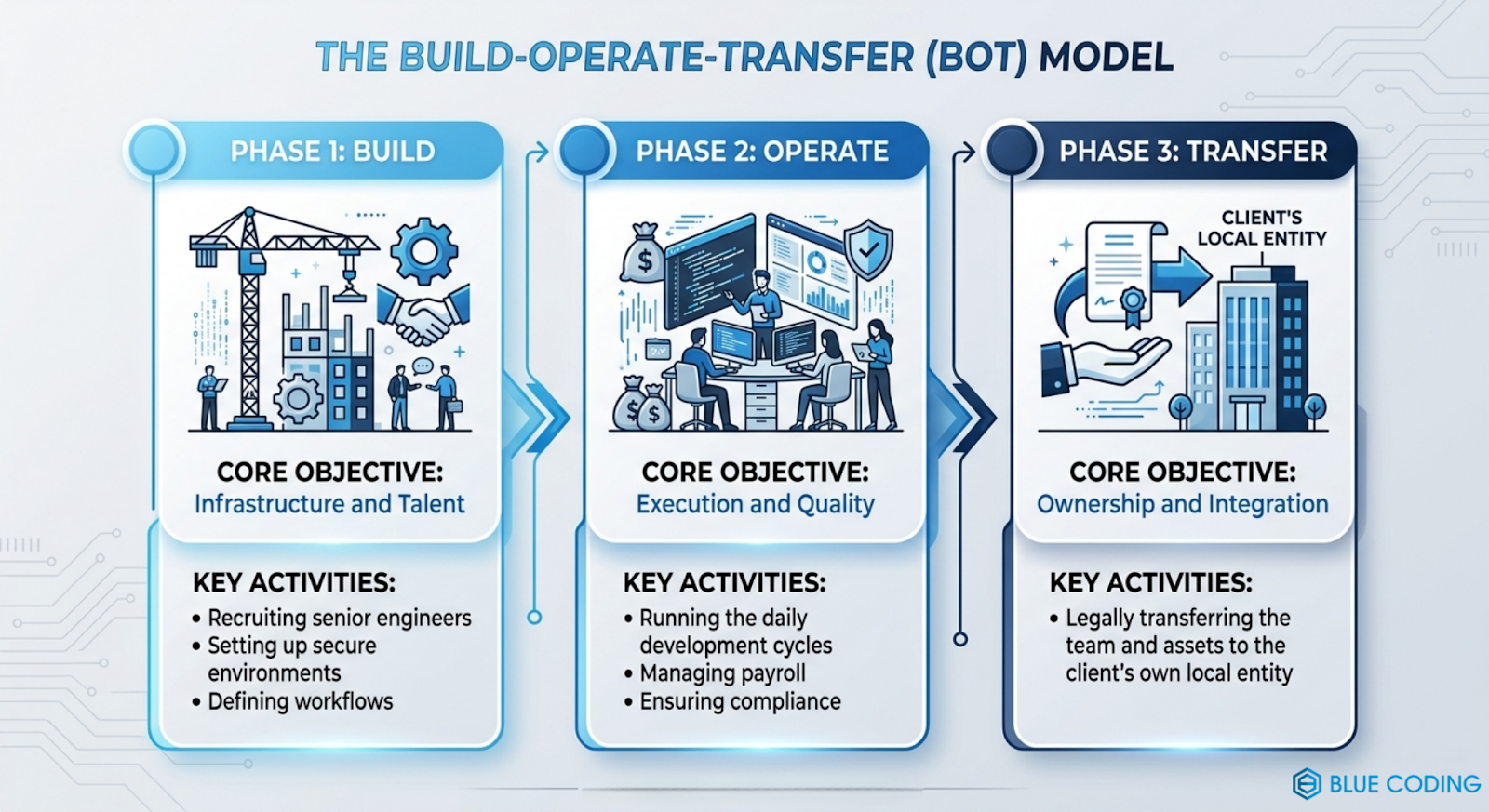
The build phase is where the foundation is laid. A local partner handles the complexities of labor laws and recruitment. In the operate phase, the focus shifts to performance. The team is integrated into the client's culture and works on core products. Finally, the transfer phase allows the client to take full ownership of a mature, high-performing team. This model is ideal for firms that want to establish a permanent presence in a region like Colombia or Mexico without the initial administrative burden.
Each country in Latin America offers unique strengths for the financial sector.
Leveraging these hubs allows for a diversified talent strategy. By spreading pods across different regions, companies can mitigate local risks and tap into different specialized skill sets.
When building nearshore fintech development pods, the technical stack must be chosen with scalability in mind. Modern finance depends on languages and frameworks that prioritize safety and concurrency. Rust and Go have become increasingly popular for high-frequency trading and payment processing due to their memory safety features.
Beyond the language, the infrastructure must be airtight. Using virtual private clouds and hardware security modules ensures that sensitive data is never exposed. The development pods must operate within a strictly controlled environment where access is granted on a need-to-know basis. This level of rigor is what separates a standard dev shop from a provider of compliant software development teams.
For a brand like BOT LATAM, the goal of a blog post is not just to provide information. It is to demonstrate authority and drive business growth. This is known as Revenue SEO. By focusing on the specific pain points of finance executives, such as compliance and scaling risks, you position the brand as a partner rather than a vendor.
High-authority content should address the reality of the market. It should skip the generic fluff and dive into the technical and strategic details that matter to a CTO or a Head of Engineering. When a leader searches for ways to build a compliant team and finds a detailed roadmap, they are more likely to reach out for a partnership. This intent-driven approach ensures that the traffic coming to the site consists of qualified leads looking for real solutions.
Blue Coding serves as a strategic partner for companies looking to access high-quality technical talent throughout Latin America. The team specializes in building dedicated software pods and managing the complexities of nearshore recruitment so that organizations can focus on their core product. By emphasizing technical excellence and operational security, Blue Coding helps firms scale their engineering capacity with precision and reliability. Contact the team today to learn how to optimize your development workflow. You can also schedule a free strategy call to explore customized staffing solutions for your next project.


Subscribe to our blog and get the latest articles, insights, and industry updates delivered straight to your inbox