Comparing hiring developers in Mexico vs Brazil? This guide breaks down the strengths of each powerhouse and highlights current LATAM software outsourcing trends that are reshaping how North American companies build products.
.jpeg)

.svg)
.svg)
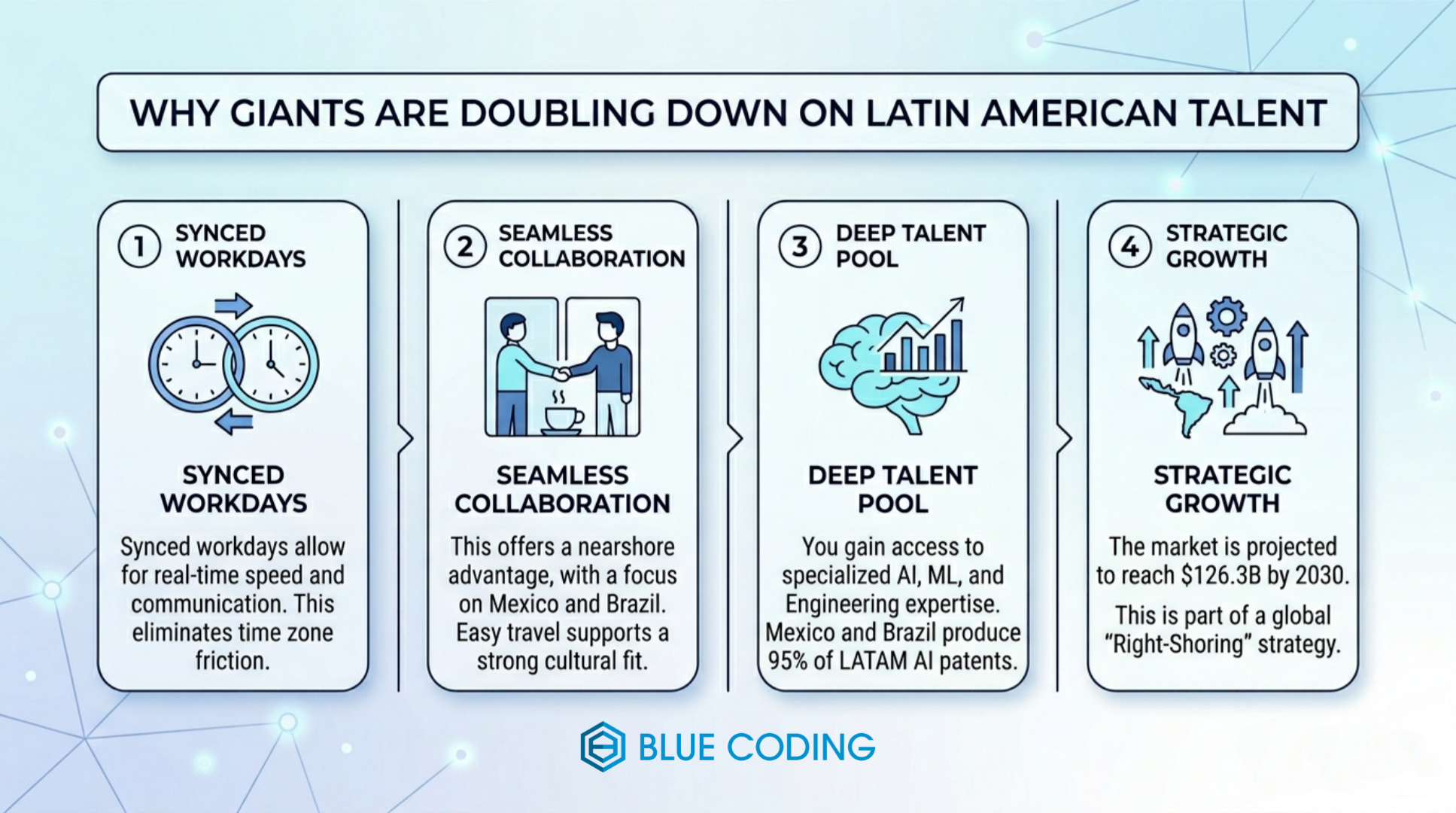
The global hunt for talent has moved from a search for the cheapest labor to a race for the most efficient, high-velocity talent. Today, the LATAM tech ecosystem is no longer just an alternative. It is the primary strategy for Fortune 500 companies and Silicon Valley unicorns alike. Recent data suggests that the Latin American software outsourcing market is projected to reach $126.3 billion by 2030, driven by a 10.1 percent growth rate that shows no signs of slowing down. According to industry reports regarding the LATAM tech ecosystem 2026, the region will likely see a 25 percent increase in specialized AI roles compared to previous years. For North American giants, the move south is about more than just numbers. It is about finding an elite workforce that operates in their own backyard.
For years, US tech companies dealt with the offshore lag. Teams in Asia offered low costs but required managers to take meetings at 11 PM or 6 AM. This fragmented communication often led to project delays and misalignment. The rise of nearshore software development Latin America has effectively killed the midnight standup.
With a massive overlap in time zones, developers in hubs like Medellín, São Paulo, and Mexico City work the same hours as their counterparts in New York, Austin, or San Francisco. This real-time collaboration allows for agile development where problems are solved as they happen, not twelve hours later. In a world where speed to market is the only metric that matters, being in the same workday is a competitive advantage that giants can no longer ignore.
The physical proximity also means that travel is much easier. A manager from a California tech firm can fly to Guadalajara or Mexico City in just a few hours. This makes it possible to have face-to-face team building sessions or intensive sprint planning without the grueling jet lag associated with eastern hemisphere travel. Nearshore software development Latin America provides the speed and the human connection that modern software development requires.
When looking at the region, most companies find themselves comparing the two biggest players. Hiring developers in Mexico vs Brazil often comes down to the specific needs of the project. Both nations have invested heavily in their technical infrastructure and education systems, but they offer different strengths for different types of businesses.
Brazil currently boasts the largest talent pool in the region, with over 750,000 developers. It has become a powerhouse for enterprise software and AI, ranking second in the Latin American Artificial Intelligence Index. If a giant needs a massive, specialized team for a complex backend migration, Brazil is often the first stop. The sheer volume of talent allows for rapid scaling that smaller nations struggle to match.
On the other hand, Mexico offers the tightest proximity to the US. Under the USMCA trade agreement, intellectual property protection and business travel are streamlined. Mexico’s tech hubs like Guadalajara and Mexico City have matured into Silicon Valleys of their own. They produce high-level engineers who are deeply integrated into the North American tech culture. While Brazil offers scale, Mexico offers seamless integration. When companies analyze hiring developers in Mexico vs Brazil, they are usually looking for a balance between the quantity of specialists and the ease of legal and physical logistics.
While cost is always a factor, the narrative around LATAM software outsourcing trends has changed. Modern tech leaders are prioritizing talent density over cost savings. They are looking for developers who can lead a project, not just follow tickets. This change in perspective is what is driving the massive influx of capital into the region.
The focus on AI and Machine Learning is a perfect example. Mexico and Brazil alone account for roughly 95 percent of all AI patents filed in Latin America. Giants like Google and Amazon have established massive operations here because they can find engineers who are not just coding, but innovating. They are finding experts in data science and deep learning who are ready to build the next generation of software products.
There is a shared business culture between North and South America. Developers in the LATAM tech ecosystem often follow the same agile methodologies and product-led growth strategies used in the US. This reduces the onboarding friction that usually plagues international teams. Instead of spending months teaching a team how to communicate within a specific framework, managers find that LATAM teams are already speaking the same professional language.
We are entering the era of right-shoring. This means placing the right talent in the right place for the right reason. Large corporations are moving away from massive, anonymous outsourcing firms and toward boutique partners who can provide vetted, high-velocity teams. This ensures that every developer on the project is a senior-level contributor who understands the business goals.
LATAM software outsourcing trends show that the region is becoming the go-to for high-stakes projects. This includes fintech infrastructure, healthcare systems, and cloud security. When a company’s entire revenue depends on the stability of their code, they choose nearshore software development Latin America. It offers the stability of a local team with the scalability of a global one. The trend is moving away from basic maintenance and toward core product development.
Each country has different labor laws and tax structures. For example, hiring developers in Mexico vs Brazil involves different statutory benefits. Mexico has mandatory profit-sharing known as PTU. Brazil has complex social security contributions and specific regulations regarding remote work contracts. However, these hurdles are minor compared to the benefits. The infrastructure in major Latin American cities now supports 50 plus Mbps fiber connections as a standard.
As we look further into the decade, the LATAM tech ecosystem will keep evolving. We are seeing a surge in specialized tech parks and smart city initiatives that attract global VC interest. This investment is creating a virtuous cycle. More funding leads to better education, which leads to more high-level talent, which attracts more global giants.
As the demand for senior talent increases, the salaries in these regions are also rising. However, the value proposition remains strong. Companies are willing to pay competitive rates for developers who are in their time zone and share their work ethic. The modern LATAM developer is often a consultant who brings ideas to the table, helping to shape the product roadmap rather than just executing tasks.
One of the biggest reasons for the success of nearshore software development Latin America is the high level of English proficiency in the tech sector. In major tech hubs, English is the standard. Companies are finding that senior developers in Latin America often have higher communication scores than those in traditional offshore locations. This leads to 75 percent fewer communication-related bottlenecks.
The expansion into Latin America is a calculated move. By leveraging the LATAM tech ecosystem 2026 growth projections, companies can ensure they have the talent needed for the next five years of innovation. The focus on nearshore software development Latin America is not a temporary fad. It is a fundamental shift in how global business is conducted. The barriers are falling, and the giants are ready to reap the rewards.
Finding the right engineers in a crowded market should not feel like a gamble. Blue Coding connects North American companies with the highest-tier developers across Latin America. We do not just find people who can code. We find team members who fit your culture and understand your goals. If you are curious about how nearshoring can transform your development speed, we provide a first free call for queries to help you map out your strategy. Book your free call now and let’s talk about building your dream team!


Subscribe to our blog and get the latest articles, insights, and industry updates delivered straight to your inbox