87% of talent professionals say hiring in-demand skills is harder than ever. Here is why staff augmentation is becoming the default fix in 2026.


.svg)
.svg)
There is a moment most engineering leaders recognize. The roadmap is real, the timeline is real, and the team is not big enough to do both things at once. Something has to give, and the options on the table are all worse than you want them to be. Traditional hiring takes too long. Agencies are expensive and disconnected. Building an entirely new team from scratch is a six-month project when you need capacity in six weeks. And yet the work still needs to get done. Staff augmentation is the model that sits in the gap between all of those options. It is not a new concept, but the way it works in practice has changed significantly, and the version that is actually moving the needle for US tech companies right now looks quite different from the body shop model that gave staff augmentation a mixed reputation a decade ago.
This post explains exactly how staff augmentation works, why it fits the way growing tech companies actually operate, and what separates the IT staff augmentation services that deliver real value from the ones that just fill seats. According to LinkedIn's Global Talent Trends report, 87 percent of talent professionals say hiring for in-demand skills is increasingly difficult, and the gap between available talent and open roles in software engineering continues to widen. Staff augmentation has moved from a contingency option to a core hiring strategy for engineering teams that need to move faster than the traditional market allows.
Staff augmentation is a hiring approach where you bring external engineers directly into your existing team on a contract basis. They are not a separate vendor team working on a separate deliverable. They work inside your workflow, your tools, your sprint cycles, and your communication channels, the same way a full-time employee would, just without the full-time employment infrastructure around them. The distinction matters because it changes the entire dynamic of how the work gets done. In a traditional outsourcing arrangement, you hand off a scope of work and receive output. In staff augmentation, you add capacity to your team and that capacity participates in how the team thinks, plans, and ships.
That participation is what makes staff augmentation genuinely useful for companies trying to hire developers faster without sacrificing the integration depth that determines whether additional engineers actually accelerate delivery.
The confusion between staff augmentation and outsourcing is one of the most common sources of misplaced expectations in the IT staffing market. They sound similar. They are operationally very different.
With outsourcing, the vendor owns the work. They have their own processes, their own management structure, and their own definition of done. You interact at the edges of the engagement, reviewing deliverables and raising concerns, but you are not inside the process that produces the output.With staff augmentation, your engineers are inside your process. Your engineering lead manages them. Your sprint defines their priorities. Your codebase is the one they are learning and improving. The institutional knowledge they build over the engagement stays accessible to your team because it was built inside your team.
That difference in knowledge retention is one of the reasons companies that have tried both models consistently prefer staff augmentation for work that requires product context and technical judgment rather than just volume execution.
The US tech hiring market has not meaningfully eased for senior engineering roles. The engineers with the specific stack experience and the demonstrated ability to work independently are still employed, still well-compensated, and still not actively looking. Reaching them through traditional channels takes time that most product roadmaps cannot absorb.
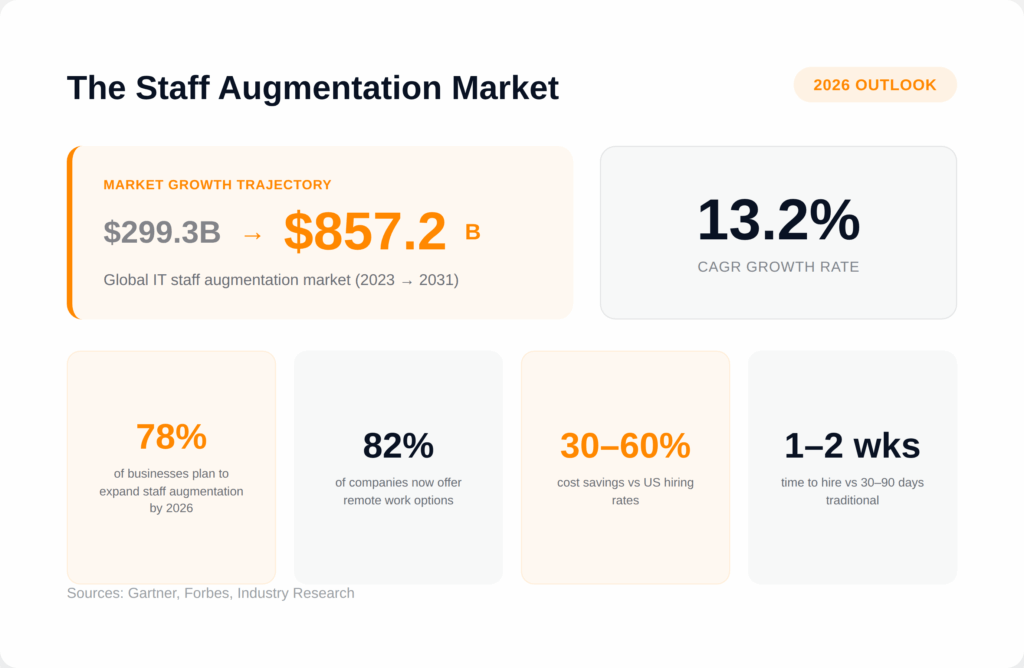
IT staff augmentation services that work off a pre-vetted talent bench change this dynamic. Instead of starting a search from scratch every time a capacity need arises, companies can move from identifying a gap to interviewing a specific engineer in a matter of days. The evaluation process is compressed because the preliminary vetting has already been done. And the time from offer to active contribution is measured in weeks rather than months. For growing tech companies running quarterly planning cycles, that compression in timeline is the difference between addressing a capacity gap within the current quarter and carrying it into the next one.
Product priorities shift. A feature that was the top of the roadmap in Q1 gets deprioritized in Q2. A new initiative emerges that requires a completely different skill set than the one the team was building toward. The engineering capacity needs of a growing tech company are not static, and a hiring strategy built entirely on permanent headcount cannot respond to that dynamism quickly enough.
Staff augmentation fits naturally into this reality. You can add a React specialist for a six-month front-end initiative and then shift to adding a DevOps engineer for the infrastructure work that follows. You can scale the team up for a product launch and back down once the launch stabilizes. You can bring in a senior architect for a specific design phase and not carry that cost through the implementation sprint where a mid-level engineer is the right fit.
That flexibility does not mean staff augmentation is inherently short-term. Many of the best staff augmentation engagements run for years because the engineers involved become genuinely embedded in the team and the product. But the option to adjust scope without the overhead of a formal restructuring is valuable in a way that growing companies feel acutely.
One of the clearest use cases for how staff augmentation works in practice is plugging a specific technical skill gap that the existing team does not cover. You have a strong engineering team but no one owns machine learning. Or you have a solid backend team but the mobile experience is consistently falling behind because no one on the team has the iOS depth to drive it properly.
Hiring a full-time engineer to fill a specific skill gap works eventually, but the timeline and the cost are often disproportionate to the actual scope of the need. Staff augmentation lets you add the specific expertise you need at the specific time you need it, without building a permanent hiring case around a need that may be scoped or temporary.
For companies navigating the US tech talent shortage, this targeted flexibility is one of the highest-value applications of IT staff augmentation services. You can read more about the structural dynamics driving that shortage in Blue Coding's post on how nearshore partnerships solve the senior developer shortage in North America.
The single biggest differentiator between IT staff augmentation services that deliver and ones that disappoint is the depth of the vetting process. A resume that shows the right stack and the right years of experience is not the same as an engineer who can operate effectively inside your specific team and product context.
Good vetting includes a technical assessment that surfaces how engineers think, not just what they know. It includes an evaluation of English communication quality, because a technically excellent engineer who cannot communicate clearly with your team creates friction that erodes their contribution over time. And it includes reference or evidence of past performance in embedded team environments, not just project completion at arm's length. The partners who do this well can tell you specifically how they assess each of these dimensions and what the failure rate looks like on their placements. The ones who cannot answer those questions clearly are relying on CV screening and hoping for the best.
Any serious IT staff augmentation partner stands behind their placements with a clear replacement process. If an engineer is not the right fit after they start, whether that is a technical mismatch, a communication issue, or simply a cultural fit problem that was not visible during evaluation, you should not be the one absorbing that cost. A replacement guarantee is not just a risk management tool. It is a signal about how seriously a partner takes their own vetting process. If they are confident in the quality of the engineers they place, they are not worried about the guarantee. If they are reluctant to commit to one, that reluctance tells you something worth knowing before you commit to them.
How staff augmentation works in the first two to four weeks of an engagement has an outsized impact on how the entire relationship performs. Engineers who are properly introduced to the team, given meaningful context about the product and the codebase, and included in the full rhythm of the team's work from the start integrate faster and contribute more meaningfully sooner. The best nearshore staff augmentation partners take an active role in making this happen. They do not just place the engineer and consider the job done. They stay engaged through the early integration period, checking that the onboarding is going well on both sides and addressing any friction before it hardens into a pattern.
For companies thinking about how to structure the onboarding side of a staff augmentation engagement effectively, Blue Coding's post on how nearshore development helps companies move faster covers the integration mechanics that determine whether new engineers contribute quickly or take months to reach useful velocity.
Not all staff augmentation for tech companies delivers the same result. The model is sound. The execution varies widely. When you are evaluating potential IT staff augmentation services, the questions worth asking directly are: what does your vetting process look like end to end, what is your replacement policy, how quickly can you get an engineer in front of us for evaluation, and what does your ongoing support look like after placement?
A partner with confident, specific answers to all four of those is worth a serious conversation. A partner who deflects, generalizes, or cannot give you concrete process details is worth reconsidering before you hand them a critical role on your engineering team.
According to SHRM's workforce research, the average cost of a bad hire is equivalent to 50 to 60 percent of that employee's annual salary. In software engineering, where senior roles command significant compensation, that math makes the quality of vetting not just a convenience consideration but a financial one. The due diligence you do on a staff augmentation partner upfront is one of the highest-return investments you can make in the hiring process.
For a broader view of how staff augmentation compares to other models for scaling engineering capacity at different company growth stages, Blue Coding's breakdown of staff augmentation versus managed teams is worth reading before you make a structural decision about which model fits your current situation.
Blue Coding is a nearshore software development and tech staff augmentation company that connects growing US tech companies with senior, English-proficient engineers from Latin America who are pre-vetted, immediately available, and ready to integrate into your team from week one. We run a rigorous vetting process that covers technical depth, communication quality, and demonstrated performance in embedded team environments. We stand behind every placement with a clear replacement process. And we stay engaged through the early weeks of every engagement to make sure integration goes smoothly on both sides.
If you are trying to hire developers faster without sacrificing the quality of who you bring in, we are ready to show you how that works in practice. Contact us to benefit from a free first call we offer with no commitment. A direct conversation about what your team needs, what our bench looks like, and whether we are the right fit for what you are trying to build.


Subscribe to our blog and get the latest articles, insights, and industry updates delivered straight to your inbox